
When Electronic Met Jazz: Five Years of Floating Points and Pharoah Sanders’ “Promises”
Five years after its release, the equal parts jazzy and electronic Promises still stands as a time capsule of the post-covid period, and a looking glass into a turbulent decade ahead.
Written by Zachary Bolash
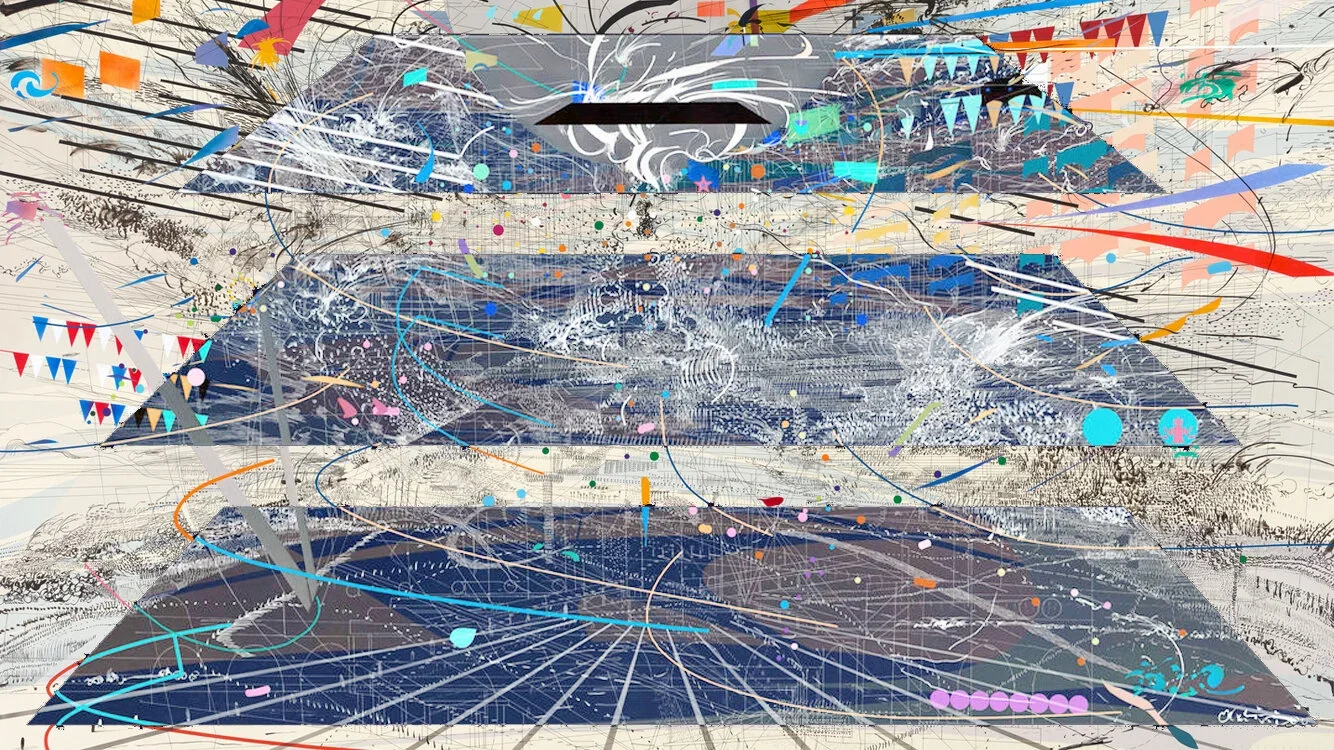
Image courtesy of Julie Mehretu
Promises is an artistic love story between a jazz great and an electronic innovator. Six years before the record’s release, the avant-garde Pharaoh Sanders, best known for his free-flowing 1969 jazz album Karma, became encapsulated by Floating Points’ electronic Elaenia. The jazz and electronic maestros formed an artistic friendship that transmuted into musical expression.
In 2019, Sanders and Floating Points began recording Promises at Sargent Recorders in Los Angeles. The COVID-19 pandemic partially interrupted the duo before they concluded at the London Symphony Orchestra, which filled in instrumental gaps from an ensemble consisting of cellos, violins, violas, and double basses. In a sense, the album comprises a trifecta of the COVID-19 years that influenced the record’s sound as it was conceived.
The record is divided into nine movements, in which the ethereal melody is iteratively developed with overlaying jazzy instruments and peculiar, alien-like synthesizers before it evaporates into spacey ambience by the final movement. The first three movements contain a sense of intrigue, like the feeling of accidentally stumbling into a fantasy world. A stringy, percussive melody continually crescendos before being interrupted by “saxxy” interludes.
These tracks seem to represent pre-COVID optimism. The movements teem with a sense of wonder and equilibrium. They feel light and airy like they could soundtrack someone meandering through the woods or taking an aimless stroll down the beach. The mood captured by these tracks perfectly encapsulates the pre-COVID zeitgeist of feeling unburdened and confident that the world shall continue untrammelled.
The next three movements, however, are marked by intangible anxiety created by the verbalizations of Pharaoh and a high-pitched organ sound that serves as a lifeline for the following movements. Moreover, the jazzy interludes are indubitably more severe, pronounced, and higher-pitched than the first three movements. The calm mystique of the first tracks is replaced with anxiety and a feeling captured by the full-blown symphony that overtakes the end of “Movement 6.”
To revisit the comparison of the 2019-2020-2021 triad, perhaps these intermediary movements represent the onset of the COVID-19 Pandemic. Our understanding of the world has been tilted by the worldwide shutdown; what is familiar is quickly overtaken by new circumstances, with the same sharpness and intensity at the end of movement 6. The final three movements, however, seem to be angling in all directions. Movements 7 and 8 are marked by the original melody dissolving into a spacelike ambience, with hazy synthesizers overtaking crisp strings. However, “Movement 9” sticks out in its nonconformity. The track is a bleak, nearly 10-minute track of dark ambience attenuated by shaky strings and deep, guzzling ambience.
Perhaps these final movements represent the post-COVID juncture. After the surge of progressivism, countered by an equally potent conservative movement, the future seemed splintered between two political realities — either that the populace would shrug off the effects of the pandemic and chart towards a progressive future, or be swallowed by an angry undercurrent of post-COVID resentment that pummels the states towards a future of instability and fragmentation.
The answer, surely, is still not clear as the world seems to oscillate between the two realities. However, what still holds true is Promises’ timeless power to be an evocative piece of art five years later.