
The Silent Puppeteer: Jazz Diplomacy and Music as Propaganda
Since the onset of the modern state, governments have sowed their ideological seeds into their citizenry with propaganda, often using music as a means to do so. But posters of pointing men line the streets no longer, and traveling jazz bands have faded into antiquity, leaving the question: Has musical propaganda stopped? Or has it just gotten sneakier?
Written by Veronica Martin
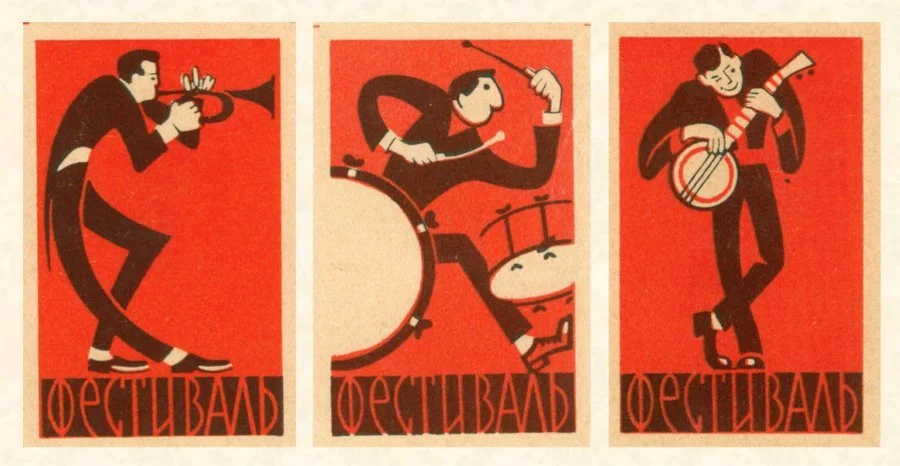
Deriving from the Latin word propagare, or “to spread,” propaganda began with an entirely neutral connotation, one that would slowly pivot to be more pejorative with its integration into national security. At its etymological core, propagare functioned as a reference to plant reproduction—the creation of new plants from seeds or one of its vegetative parts. Its biological implications shifted in the 16th century under Pope Gregory XIII, who co-opted the word when he established a commission of cardinals, “sacra congregatio de propaganda fide,” whose duties were to spread Catholic gospel and proselytize “un-Christian” lands. The meaning remained consistent all the way until World War I, when “propaganda” came to denote the extensive campaigns orchestrated by warring governments to convince belligerents of their causes’ righteousness. The “exaggeration” and “falsehood” intrinsic to wartime information campaigns would thereafter act as synonyms to a word that had been neutral for centuries.
Quite quickly, states grasped the potency of skillful instrumentation and lyricism in the pursuit of greater strategic objectives — propaganda as soft power was now “in”. Jazz diplomacy exemplified this concept in full, but not before a bit of ideological tug-of-war. In the late 20s with Stalin’s assumption of authority in the Soviet bloc, a short era of permissiveness towards jazz came to an abrupt halt. The previous air of passivity towards Western-adjacent culture was willfully replaced by a hardline opposition to all things “foreign bourgeois.” By the mid 1930s, the Kremlin loosened its grip, attesting that it had achieved “victory in constructing the foundations of socialism” during its stint of militarism. In 1938, the Soviet Union formed the State Jazz Orchestra of the USSR in an effort to include the proletariat in the arts. Almost immediately, this move would be undercut by its relegation to inferiority to the “high arts,” which the government sought to support in its stead. Back for seconds, Soviet policy shifted once more towards isolationism, leading to a renewed clampdown on Western jazz. A distinction between “acceptable” Soviet jazz and malignant American jazz emerged, though the former severely lacked the spontaneity and danceability integral to its Western counterpart’s. In the later ‘30s, jazz was once again permitted as a soothing mechanism for troops in the Second World War, but would soon be retracted in another bout of Stalinist anti-Westernism. Such back-and-forth would continue well into the 20th century.
As tensions with the West reached their peak in the middle of the 20th century, the Kremlin cracked down on Western influence in Soviet arts and culture, arresting most prominent jazz musicians from the war in 1946 and launching a full-fledged campaign in 1948 to finish the job. The Soviet relationship with jazz was thus an oscillating one, marked by severe bouts of censorship and support that oscillated with the ideological and political zeitgeist. Just as jazz bands during the war met far-reaching approbation from the Kremlin as cultural entertainment to the Red Army, such reprieve would not be extended into the next decade.
The 1950s marked greater Western cultural penetration into its Eastern adversaries. Jazz quickly became central to the American State Department’s strategy in communist nations, because unlike classical music, theater, and ballet, jazz was seen as endogenous to the U.S.--it was uniquely American. As such, American jazz became an ipso facto symbol of democracy. The ascent of Voice of America (VOA) exemplifies this phenomenon.
A CIA invention launched two months after the United States’ entrance into World War II, the VOA acted as an escape from politics for listeners behind the Iron Curtain. While American jazz groups were prohibited from touring the Soviet Union, a lively black market of bootlegged recordings of VOA’s jazz hour — otherwise known as Music U.S.A. — sold for the equivalent of forty dollars. Nestled among the growing, youthful penchant for jazz was an appreciation for American culture and, subsequently, an undeniable growing resentment towards a restrictive regime.
By 1962, the juggernaut that was jazz could be denied no longer—its soft power had been fully realized. The white clarinetist and “King of Swing” Benny Goodman was selected by the Department of State to perform with a racially integrated band in Moscow. Most important of this performance, aside from its high attendance, was the presence of one figure in particular: Soviet Premier Nikita Khrushchev. Khrushchev’s comments towards the music were ambivalent and dismissive at best, but signaled a striking shift in the Kremlin’s jazz dry spell: public opinion was playing a role in Soviet affairs. In a later remark, Khrushchev quips at the mounting influence that American cultural pressure had put on the Kremlin. With an unanticipated amenable tone, he jokes: “Like the father who plays music for his cows…it’s not that he loves music, just more milk.”
Though of course, jazz by itself didn’t win any wars, musical and cultural diplomacy were undoubtedly titans of political renovation in the Soviet Union. The USSR was forced into acquiescing to the demands of a thirsting body politic, one eager for even a whiff of the culture beyond the Iron Curtain. However, soft culture is not merely a force of the past. Studies of previous methods of political or cultural subversion invite questions of modern-day musical propaganda and propaganda in general. How do modern governments navigate age-old diplomatic qualms such as war, ideological rifts, and public sentiment?
Unfortunately, the answer is not as glamorous as “touring jazz bands” and “radio broadcasting.” In fact, modern-day musical propaganda is quite insidious, yet still furtive at its core. Artificial Intelligence, for one, has made its recent debut as a key player in the music landscape. Recent developments have skyrocketed its capacities for human-like behavior, including the ability to create entire musical arrangements. The “band” FAKEMUSIC boasts a handful of tracks that display the instrumentation, impressive “vocals,” and structure of a true song, even categorizing it as “soul/funk.” A lively guitar solo and the occasional ad lib drape it in a jarringly human-shaped cloak, and impassioned lyrics tell a plagiarised story. Where listeners could once rely on pure instinct to distinguish robot from not, the lines are getting fuzzy, and naturally, discernment is fuzzier. Of course, propaganda need not be purely political; social propaganda is just as much of a force to be reckoned with.
A population lacking discernment and adequate judgment is a populus that is easier to control. Waning trust in personal instinct is a weapon of obedience. Many argue that the influx of content by Artificial Intelligence is a tool by which to weaken trust in institutions and information to enable an ignorant, unknowing polity. Tin foil hat or not, the categorization of a song made by A.I. as “soul” is not only deeply ironic but especially dystopian. Soul music is a product of centuries of human — particularly Black human — struggle and cultural flourishing, two elements that are exclusive to the mortal experience.
Adages abound as to the nature of war and its consequences, but modern-day propaganda is playing a different game than what it always has. Jazz diplomacy, the Berlin airlifts, and propaganda posters all fought soft-powered wars of ideology, but the ideological divide is somewhat of an obsolete rift. As we strip away the tools and mechanisms that are uniquely human, merely the carcass of personhood remains. In fact, in the pursuit of raw mortality, modern propaganda has delivered on its promise of deception. But state borders are the enemy lines of the past, and propaganda fights a battle of ideology no longer. The new distinction is DNA, and French philosopher Jacques Ellul said it best: “Every modern state is expected to have a Ministry of Propaganda, whatever its actual name may be.”