
Chicano: The Movement, the Identity, and the Music that Live On
Chicano culture goes deeper than just a stereotypical image many may have, and certain artists are still prominent, from Thee Sacred Souls, to Brenton Wood, or Los Yesterdays.
Written by Jayda Carrejo
Illustrated by Jenya Rajamani
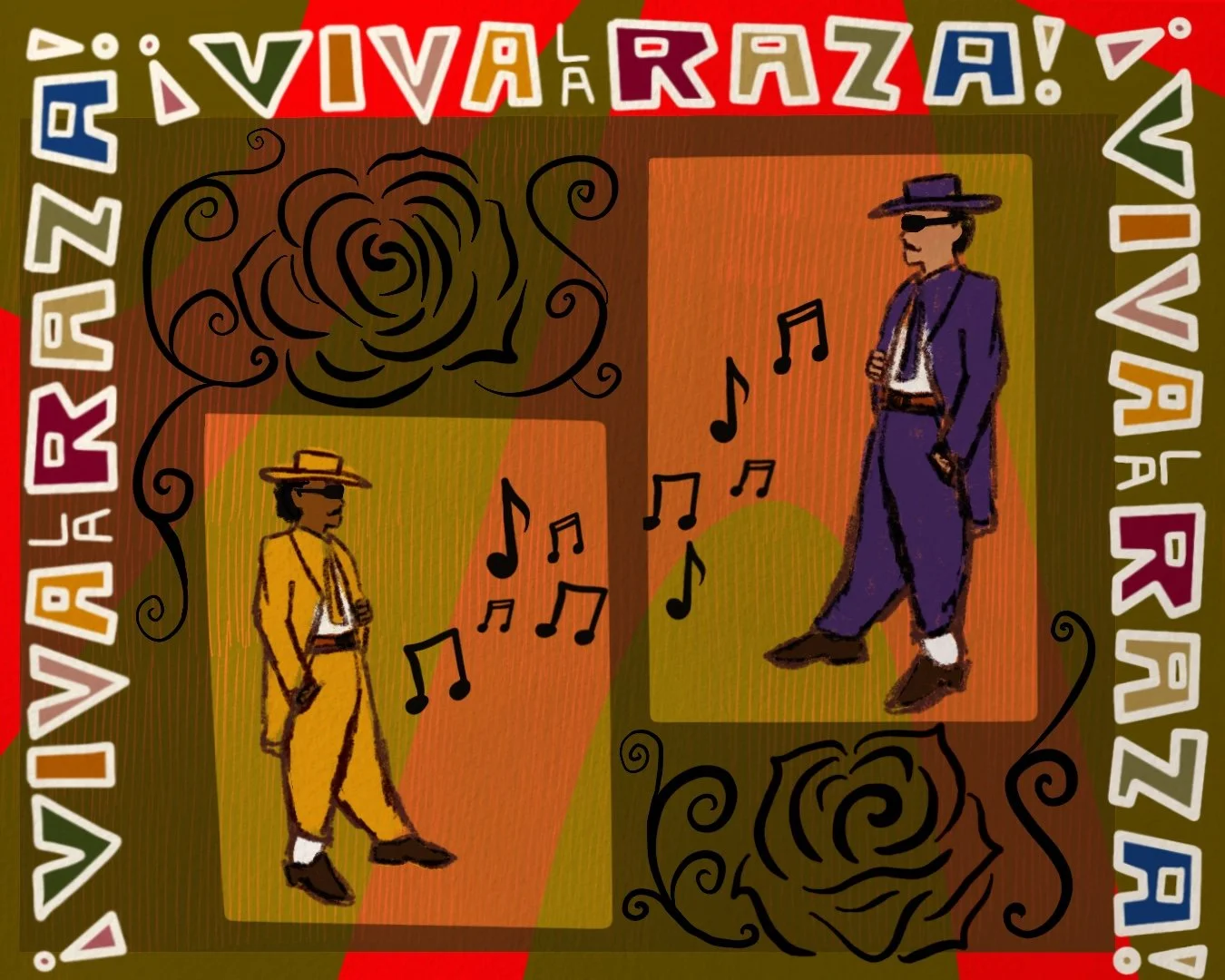
In the dark indoor music venues, festivals like Austin Psych Fest often feel heavy —not just with the heat, but with a specific, velvet-textured quality. It’s the kind of festival that contains artists with music that slows time: rolling bass lines and soft vocals of love songs. On the surface, the rise of groups like the festival’s headliner, Thee Sacred Souls represents an interest in the "vintage aesthetic," a curated nod to the "lowrider vibes" of a bygone era. For example, their hits, like "Will I see you again?” or "Easier Said Than Done," are typically associated with a certain vibe. Though they are often relegated to the background of summer picnics or family gathering playlists, for the Chicano and Chicana community, this music expands beyond background noise. The soft snaps that are portrayed in the background of simple but sharp snare beats and a soft, rich baritone voice, accompanied by sharp and whistle-like hums. The intriguing compilation of these rich sounds overlaps in admiring synchronicity throughout songs of passion, such as “Easier Said Than Done.”
Beginning in the 1960s, unfair treatment of minorities, segregation, and political violence led to the sonic residue of El Movimiento, the Chicano Movement, that sparked a radical re-evaluation of identity. A refusal to remain on the margins of a society that sought to displace Mexican Americans from their cultural homes persisted as one of the movement's leading goals. To understand the depth of this "souldies" resurgence, one must look past the polished chrome and crisp Dickies, and into the "internal war" that birthed a revolution.
The 1960s were a crucible-defining time. The United States deployed soldiers from its military to the jungles of Vietnam, and Mexican Americans were called to the fight, which started to brew in the barrios of East Los Angeles and the dusty colonias of South Texas, introducing a different kind of conflict. By the late 1960s, Mexican Americans were dying on the front lines in numbers that far exceeded their share of the population, serving a country that often denied them basic human rights at home.
This disparity catalyzed a generation. The community realized that their most urgent war wasn't across the Pacific; it was being fought right in the streets of America. This era gave birth to powerful revolutionaries who amplified the voices of Chicano youth. We see it in the legacy of Cesar Chavez and Dolores Huerta, who fought for the rights of the farm workers supporting the American agricultural machine. Despite their crucially abundant work, the corporations still treated these workers as an invisible minority.
As the Black Power and Chicano movements intersected in the streets, they also intersected musically. The two political groups had connected in reflection of their oppression. In the belief of eliminating voter suppression, fighting police oppression against minorities, and promoting community strength, the collaboration brought the goal of an equal future. This wasn't just a political alliance, but a profound cultural exchange. Realizing they were being treated as "lesser than" by the same systemic structures, Black and Brown communities found a shared space in music.
Intersectionality: the "Eastside Sound," a genre that allowed artists from East L.A. to San Antonio to translate their pain into a shared artistic language, allows specific voices to be heard. To find the heartbeat of this movement, look to the artists who embodied this intersection. Brenton Wood was born in Shreveport, L.A., and raised in San Pedro, CA. Wood became a quintessential figure for the Chicano community. His 1967 album, Oogum Boogum and Baby You Got It, offered a transformative feeling of finding "good times" in the midst of fighting moments. His music acted as a transcendent of division in culture symbol for the resilience of East L.A. Chicano culture. For a community facing police brutality and racial discrimination, Wood’s smooth, playful sound delivered radical joy.
The impact reached far beyond the West Coast. In the southern parts of Texas, the Chicano experience complicated the unique reality of border town life — a constant negotiation of dual identities. It's here that Sunny Ozuna emerged as a pioneer. When Sunny and the Sunliners converged their instruments and voices playing on Dick Clark’s American Bandstand in 1963, a seismic shift occurred. By becoming the first Latino artist to appear on the show, Ozuna broke through media barriers that had previously ignored Mexican American talent. His hit "Talk to Me" reached #11 on the Billboard Hot 100, proving to a generation of Chicano youth that "we can do this too." A song that has this slow rhythm and raw vocals of a heartfelt song about communication in a relationship of pure love, it wasn't just about a chart position, but who glimmered and exulted in place amongst the dominant.
To the outsider, Chicano culture is often reduced to a set of visual tropes: the polished chrome of a lowrider, the sharp crease of a pair of pants, the meticulously groomed hair. But these symbols were never purely stylistic, but influential in the music as well. The tempo of Chicano soul mirrored the movement of the cars and the pace of the community’s resilient emotions. The lyrics created during this time connected the collective experience of generations. Songs of love interlock longing moments of peace from the intersectionality of inner problem of being Chicano at “home” and ethnicity being underrepresented. The lyrics of the anthem song “Suavecito” by Malo, “ Suavecito, mi linda/ suavecito/The feeling /The feeling that I have inside for you/ Cause ever since the day I met you/I knew that you were my dream come true.”
Fast forward nearly 60 years, and the "prodigy" of a people once unseen now commands to be celebrated on a global stage. Thee Sacred Souls evokes and mirrors the direct heritage of the harmony-heavy past. When you hear the romantic layers of their discography, you hear the amends of different races coming together. A reclamation of the "soul" in Chicano soul, honoring the Black and Brown collaboration that defined the 1960s. Their lyrics from “Give Justice,” “ There'll be no peace / Until there's justice / Until there's justice / Could've been me/ It could've been me” signify the band's fighting and call to action messages contrasting with their melodic love songs, such as the sweet and heartwarming “Can I Call You Rose?”
Chicano Batman is a modern band that continues Chicano music’s revolutionary sound. Their song "La Jura" speaks directly to the current social issues of police overreach, a haunting echo of the same struggles faced by the revolutionaries of the 60s. They use the same vintage textures, the same organ swells and fuzzy guitars, but they apply them to the Hispanic experience with government officials today. With lyrics such as, “Los que deben proteger / Hacen lo opuesto/ Matan inocentes” (Those who must protect / They do the opposite / Innocents killed). The song of police brutality was the call of fear and a reflection of marginalized communities being affected by this abuse of power.
It is the sound of La Raza — low, slow, and eternally resilient. All those who have found their people in their shared music experiences, which now open opportunities for countless artists amongst different genres to reach their greatest potential.West Texas local Tony Jupiter is just one product of these expanded opportunities. While perhaps not as popularly noted as Thee Scared Souls or Chicano Batman, Los Yesteredays and Thee Sinseers show that community is everything, and culture fought for in La Raza will continue to progress as the two artists from East L.A. continue to perform their rich music. Taking Los Yersterday for example, a band born from the dreams of producing the heirloom of generational music. Weaving their style of fast-paced piano keys being played, one that may give listeners an enthralling experience while allowing a raspy and broken-up voice of emotion to be heard. Similarly, Thee Sinseers wanted to bring their confidence and the amazement of the lead singer Joey Quinones' direction, drawing on a role model in a similar culture, such as Richie Valens.
So, as the lyrics of Thee Scared Souls’ “Lucid Girl,” “There is a girl who wanted change (ooh, oo) / Something different from what she knew (ooh, ooh)” play. Perhaps the lyrics of “Trade of Hearts”, “So, let me trade you a heart for a heart / I will,” will follow. To see Thee Sacred Souls, this is more than the experience of being in a dark, packed room at a local psych festival. It is the lyrics of self-expression to the purest love from those who inspired it, and the culture of the creative who performs.