
Democracy Sings: The Song of the Carnation Revolution
Portugal was one of the last countries in Western Europe to transition away from dictatorship. The country's unique history is directly tied to music, with Jose Afonso’s “Grandola, Vila Morena” playing an ubiquitous role in the nation's transition to democracy.
Written by Declan Garvey
Illustrated by Fiona Randazzo
The year was 1974, and Portugal was in the midst of a repressive authoritarian regime led by Marcelo Caetano. The country was involved in multiple bloody colonial wars as it struggled to contain the surging independence movements. Development was stunted by a government budget primarily funding the military, and tensions were skyrocketing over the government's increasingly inconsistent handling of the conflicts. The Portuguese gross domestic product per capita, a signifier of standard of living, was one of the lowest out of all Western European countries. Portugal and Spain remained the only two dictatorships in Western Europe, their neighbors having already embraced democracy and liberty. It was under these pretenses that the disdain for the dictatorship began to swell, an era which was known as Estado Novo (New State), became unpopular, people were itching for democracy and discontent simmered.
Portugal was faced with the predicament of how to force a transition away from such a dictatorship. The task appeared daunting, with the Iberian peninsula serving as a bastion for authoritarian regimes in Western Europe, with their neighbors in Spain still under the rule of Francisco Franco and the regime having decades to entrench its power and control. They had established an effective secret police, which cracked down on political dissidents, and tried to force the masses into political submission. Portuguese democracy faced an uphill battle. Although the times were changing, much of Western Europe was witnessing a flourishing of social democracy movements, which were built upon democratic ideals, and Portugal too was seeing a rise of such movements nationwide. These fledgling ideas began to be reflected in the music of the nation, with protest songs becoming increasingly more popular and representative of these growing ideological beliefs.
Jose Afonso was a Portuguese folk singer and songwriter who created highly political compositions that critiqued social injustice and repression. He was popular domestically, with his albums receiving critical acclaim and winning various awards. However, the political nature of his works and his association with pro-democracy beliefs would result in him facing censorship from the government. He was forced to cancel concerts, parts of his discography were banned from being aired on the radio, and he even spent 20 days in prison as a political prisoner. Although hugely influential, he was initially unaware of the vital role he would play in Portugal's transition to democracy.
The dictatorship was unwavering in its support for Lusotropicalism, a quasi theory that, to briefly summarize, is the belief that the Portuguese were better colonizers than the rest of Europe. However, this fanaticism came at a cost. The armed forces had grown restless, with a path to military victory in their many colonial wars only a pipe dream, as resistance movements were only growing in strength, casualty numbers rising, and the conflicts becoming economically unviable. A group of officers within the armed forces, wanting democratic and military reform, began plotting a coup. It was an eclectic mix of young officers with no clear dominant ideology to guide them other than a disdain for Portugal's current state. Many had seen first-hand fighting in the colonial wars, most were believers in democratic reforms, and some even had connections to the Portuguese communist movement. Others were motivated primarily by anger towards the government's military reforms that had decreased the power of military academy graduates. This inevitably led the paths of Portuguese democracy, the Portuguese military, and Jose Afonoso to cross.
The coup plotters needed a way to signal that the operation was beginning, and decided that Afonoso’s song “Grândola, Vila Morena” would be their chosen message. Close to midnight on April 24, a Portuguese radio station played the first of two highly impactful songs. An unaware disc jockey played “E Depois do Adeus” by Paulo de Carvalho, the Portuguese entry to the 1974 Eurovision competition. Carvalho's song feels like a mix of Frank Sinatra and bossa nova, with various horns ringing throughout, glitzy piano fills, and crescendos placed throughout the song. The lyrics are brooding and lovesick, with Carvalho reflecting on his feelings after the collapse of his relationship. A yearning love song about a relationship gone bad feels fitting given the context of how the dictatorship in Portugal came about. The first Portuguese Republic fell in 1926 following a military coup, resulting in an established dictatorship. The coup plotters in 1926 hoped that installing a dictator would help to stabilize an increasingly chaotic Portugal. Over time, as the realities of the arrangement would become increasingly more apparent, they realized they needed change, which a coup could provide, and to quote Carvalho, “Morri nele / E ao morrer /Renasci” (“I’ve died in it / and after dying / I was reborn”).
Carvalho’s singing signalled to the conspirators that the coup had begun and to prepare for action. A few minutes after midnight, “Grandola, Vila Morena” rang out over the same radio station, telling the plotters to capture strategic points throughout the country. With Afonso’s singing, Portugal entered the unknown.
“Grandola, Vila Morena” feels like the perfect song for such an occasion. The song starts with only the sounds of footsteps marching in sync that slowly build in volume. As the marching continues, Afonso begins singing, his style highly reminiscent of American folk singer Pete Seeger, with his clear, articulate, and liberal use of vibrato giving it a cosy and approachable feel. The choruses are sung ensemble, giving it a sense of warmth and togetherness. The continued sounds of marching in the background, the spirited choruses, and acapella nature create a musical aesthetic that can be described as an army marching cadence written by a folk singer. Lyrically the song speaks about the Portuguese seaside town of Grandola, with lyrics that recall the fraternity and unity within the settlement. “Em cada esquina um amigo / Em cada rosto igualdade / Grândola, vila morena / Terra da fraternidade” (“On each corner there's a friend / In each face there's equality / Grândola, swarthy town / Land of fraternity”). Although the words are only in reference to a single specific town, the overall themes of togetherness and cooperation feel extremely relevant as the country marched into an unpredictable future.
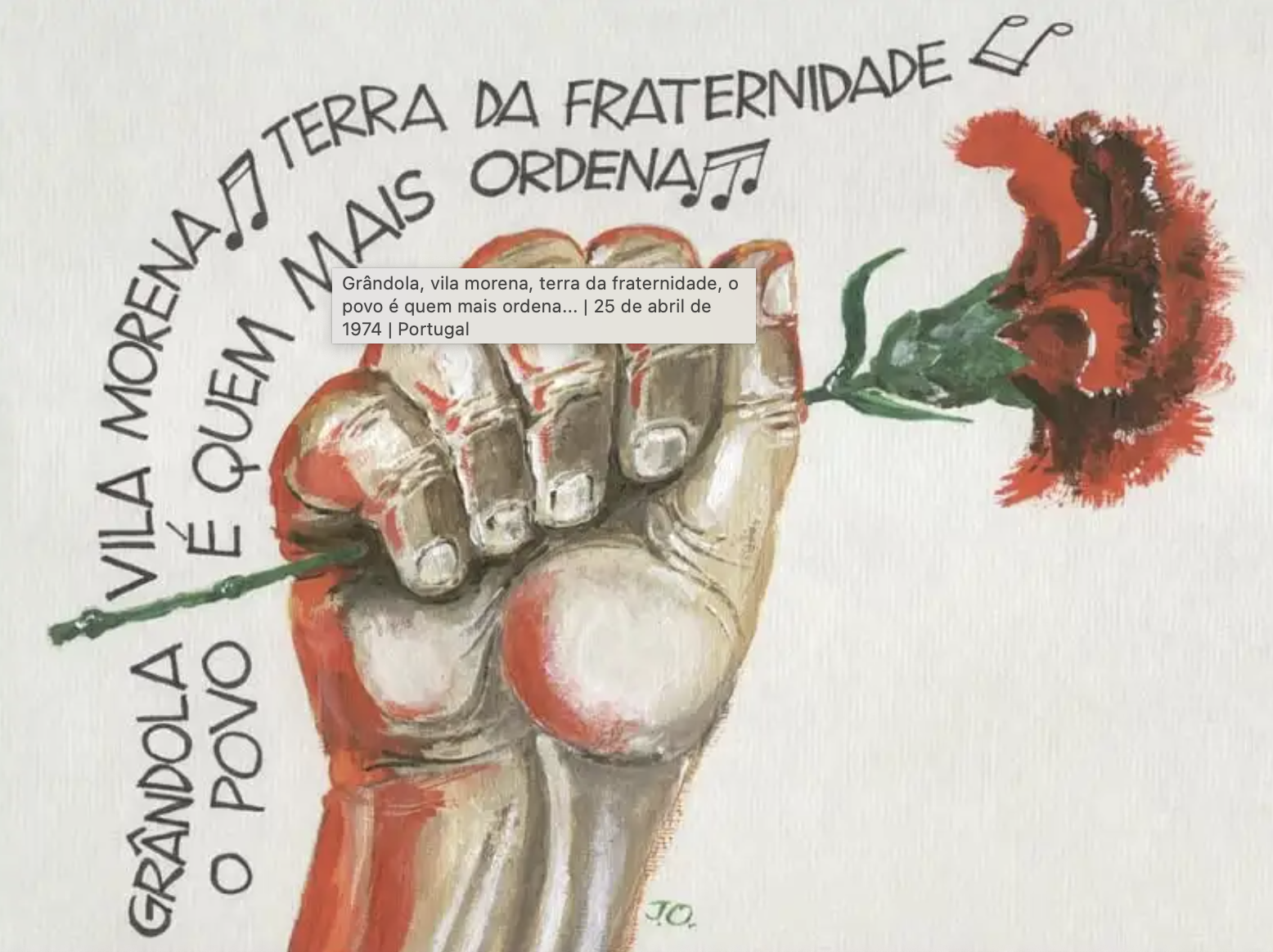
Photo courtesy of Pongamos que Hablo de Madrid
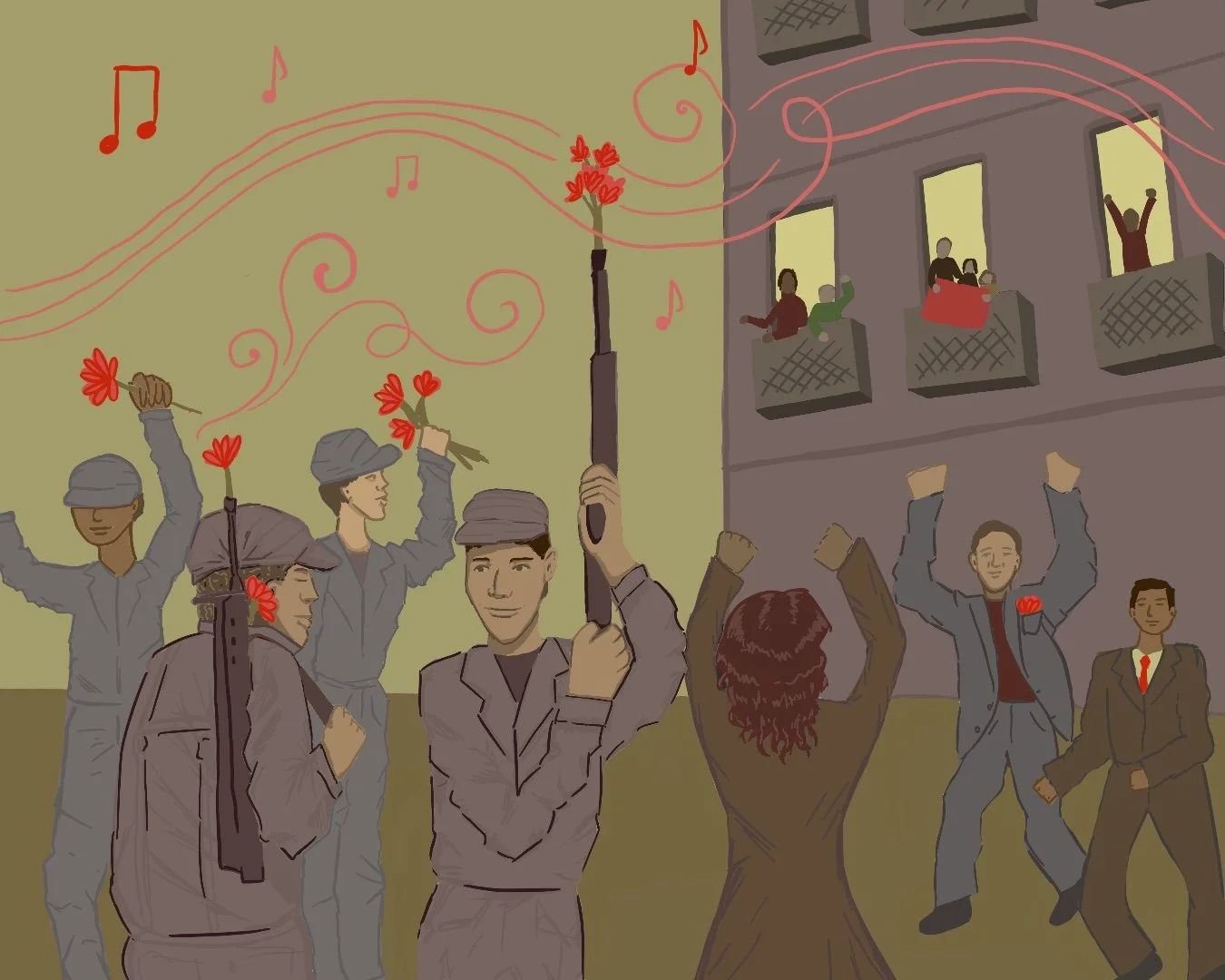
As the coup plotters overwhelmed governmental forces and captured their strongpoints, the Portuguese military dictatorship crumbled. People began flooding into the streets as the news of the movement spread, with many flocking to the Lisbon flower market. Carnation flowers were in season, and quickly the revolution would take up the name “The Carnation Revolution.” Many of the revolutionaries placed the flowers in the barrels of their guns as Afonso sang out, “O povo é quem mais ordena” (“It is the people who lead”).
Following the revolution, Portugal faced a period of unrest as the country moved towards democracy. This included protests, strikes, and coup attempts, all destabilizing the process. However, in 1976, Portugal hosted free and fair elections, bringing in a new civilian government that had received the backing of the masses. To this day, Portugal continues to be a proud democracy, with the country ranking highly in terms of freedoms. The legacy of “Grandola, Vila Morena” remains strong too, with the song becoming an anthem of democracy and anti-authoritarianism within Portugal, helping to maintain its popularity over half a decade after its release. On April 25 each year, when the Portuguese celebrate Freedom Day to mark the overthrow of the dictatorship, one will hear Afonso singing and the sound of footsteps marching, as “Grandola, Vila Morena” plays to mark the occasion.