
My Afterglow Moment: How Pears Came to be My Favorite Fruit
How my love for The Red Pears deepened after I transitioned to college, went through relationship loss, and began to find myself.
Written by Jayda Carrejo
Photos courtesy of Jayda Carrejo
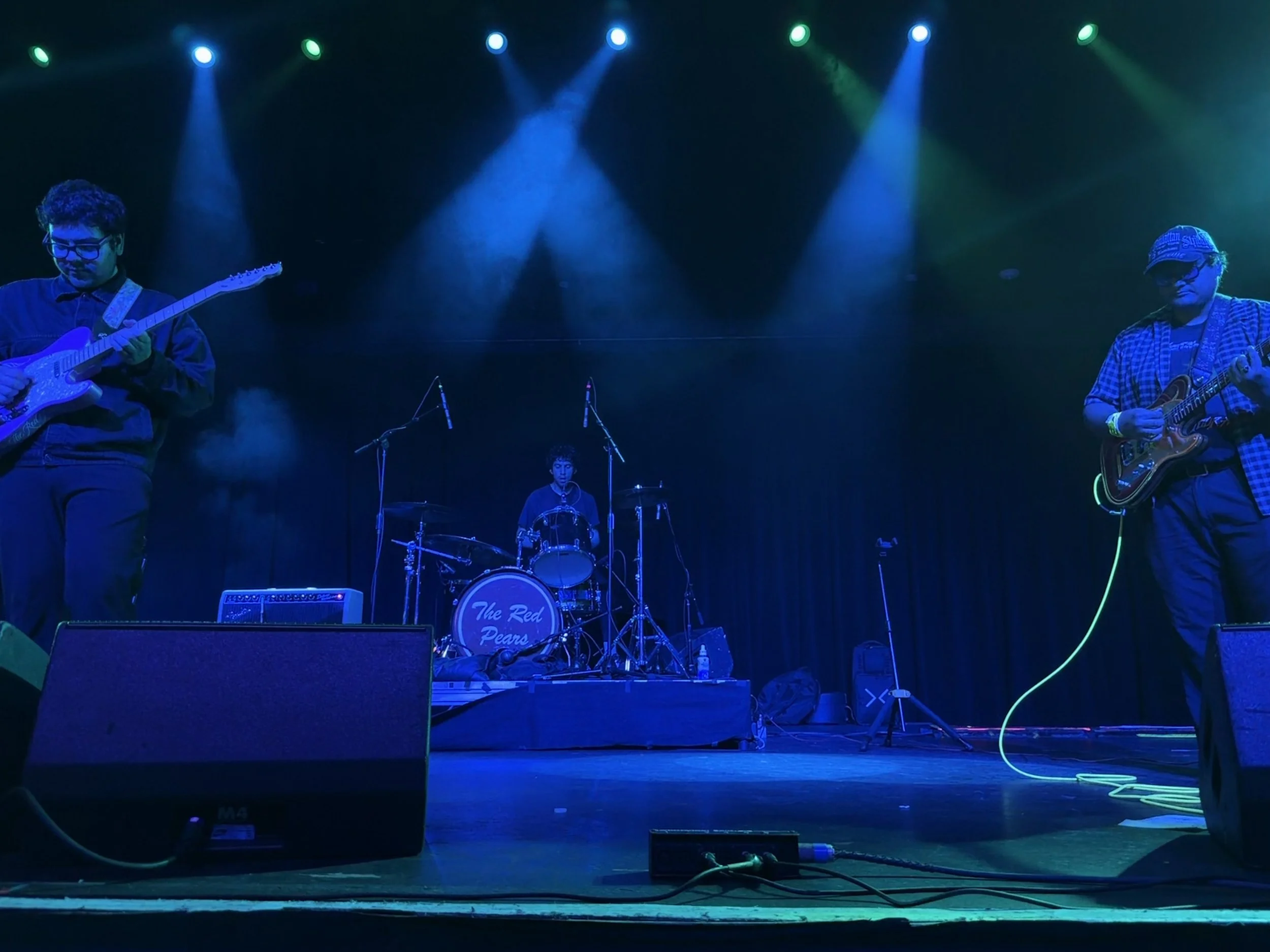
The discovery of a band is rarely a matter of simple acoustics; it is an act of spiritual reclamation. In a world where so much of our existence is inherited — our names, our histories, our expectations — discovering a melody that is uniquely applicable to one’s own life is a quiet, necessary revolution. For me, that revolution arrived through a pair of blue Sony headphones carrying the garage-rock grit of The Red Pears into my awkward youth.
I first stumbled upon “Somehow” in the eighth grade. The song was adrift in the world for years before it found me, as if the universe was holding on to it until I was vulnerable enough to hear it. It was the first thing — tangible or intangible — that I unearthed entirely on my own. No one recommended it; no algorithm whispered its name. It simply existed, a sudden frequency in the static, and then, all at once.
I remember sitting on a sun-bleached curb after school, the salt of sweat drying on my skin while the day’s exhaustion evaporated into the humid air. I was waiting for my grandfather to arrive — sometimes in my mother’s car, sometimes in an aunt’s car, and sometimes in his own. In that liminal space between the child I was and the person I was becoming, the lyrics began to pulse.
“Somehow” functions as a thesis for the band’s entire ethos: a minimalist arrangement that relies on a persistent rhythm of the snare drums gently racking to the transition of the symbols, lightly taking over and gradually accompanied by quarter beats melody of a Fender Stereocaster to mirror desperation. At thirteen, I heard the lines — “It's harder than before / The olden times they sit right now beside me / So tell me tell me when” — and I thought the "olden times" were a person, or perhaps a destination I hadn't visited in a while. I didn't realize then that the song was a premonition. I didn’t know that the path I was finding pointed towards my own autonomy, a survival guide for a future relationship, and a move that would redefine my meaning of home. By high school, I had memorized their catalog like scripture, but I was still merely an observer appreciating the shadow of a mountain I had yet to fully climb.
The first person I dared to show the band to was my dearest friend and old partner. Sharing the music felt like surrendering a piece of my secret journals. I treated my identity as a fortress to be guarded rather than a garden to be shared. But I let them in, and the songs began to feel real in a new, shared dimension. “Wait for a minute, wait for a while / I could just be there / Bring down the towers ... I can see your big eyes.” I let our relationship be guided by the music. We grew with the band, letting their chords weave into the fabric of our shared life. But it wasn’t until I moved to Austin for college that the music began to bleed into my life to its fullest extent.
My transition to UT Austin was more than a change of geography; it was a reckoning with uncertainty. We spend our youth under the delusion that if we desire something with enough ferocity — a future, a person, a dream — it is guaranteed to us by the sheer gravity of our want. But as I navigated the limestone corridors and the isolating hum of West Campus at night, the dissolution of this notion forced a truth upon me: Nothing is guaranteed.
The Red Pears became the soundtrack to this unraveling. Their lyrics were an autopsy of my internal dialogue. I found myself replaying the questions from “Somehow” with a new, terrified clarity: “But tell me tell me when / Did everything go wrong?” There is an ethereal sorrow in the way the "olden times" don’t disappear, but settle beneath you. Moving to attend UT Austin created this transitional rift of what once was, and the ability to find stability in a frantic new environment. Their music acts as my own catharsis to connect with submerged and rediscover parts of myself.
Musically, the band utilizes a clean, jangling guitar tone that feels nostalgic, yet it’s frequently undercut by a raw, frantic vocal delivery. This contrast creates a sonic afterglow — the light that lingers after the intensity of instrumental heat has gone. Everything feels "nice" and I ponder on a life that is supposed to come and a future that I had projected in my head and have all the possibilities of creating.
The song "It's Alright" took on a visceral weight during those lonely nights where I was figuring myself out for the first time without anyone telling me who to be. The repetitive, cyclical nature of the guitar riff served as a representation for the realization that I had after personal and relationship changes: “There are many things you say but I don't mind ... As long as you know you meant it / Even if it hurt me / I'ma take it light.” The simplicity of these lyrics is their primary strength; they don’t hide behind metaphor. The track taught me that pure love requires a terrifying level of honesty, even when that honesty marks the end of an era. To "take it light" wasn't to dismiss the hurt, but to acknowledge it without letting it swallow me — especially when I was far from home, with no house to run to and no shoulders to cry on.
I realized then that we can never truly be sure of anything — not the city we inhabit, not the people who promised to stay, and certainly not the version of ourselves we meet in the mirror at 2:00 a.m.. The Red Pears’ span of discography, from the driving energy of For Today, For Tomorrow to the haunting depths of For What Was, What Is, For What Could Have Been, traced the very outline of my own growth. Through their simple but passionate lyrics, they taught me the agonizing beauty of a love that exists without a safety net.
In the midst of college’s crushing weight, I found solace in the album We Bring Everything to the Table Except Tables We Can’t Bring Tables to the Table. The title captures the poetic absurdity of our condition: we show up with our hearts, our work, and our voices, even when we lack the very foundation — the table — to hold it all up. The album’s grainy, intercom-like vocal quality and the ominous slowing of the drums mirror the looping cycle of growth, such as the shallow but mighty subtle reverbed shout of the track “What’s the Difference;” the dry drums and crisp snare paired with distorted shouts of questioning in “Do You Got the Time?”; or lyrically, in "Run N’ Hide": “Take it from this time / Be the one you want to be... The last goodbye is bittersweet / I got to have you on your feet.” We are forced to grow, not because we are ready, but because the universe does not pause for our healing. The words shared the personal struggles of wanting to escape and be in a safe retreat, and for me, even if that meant going through the awkward ending of a connection to find grounding moments.
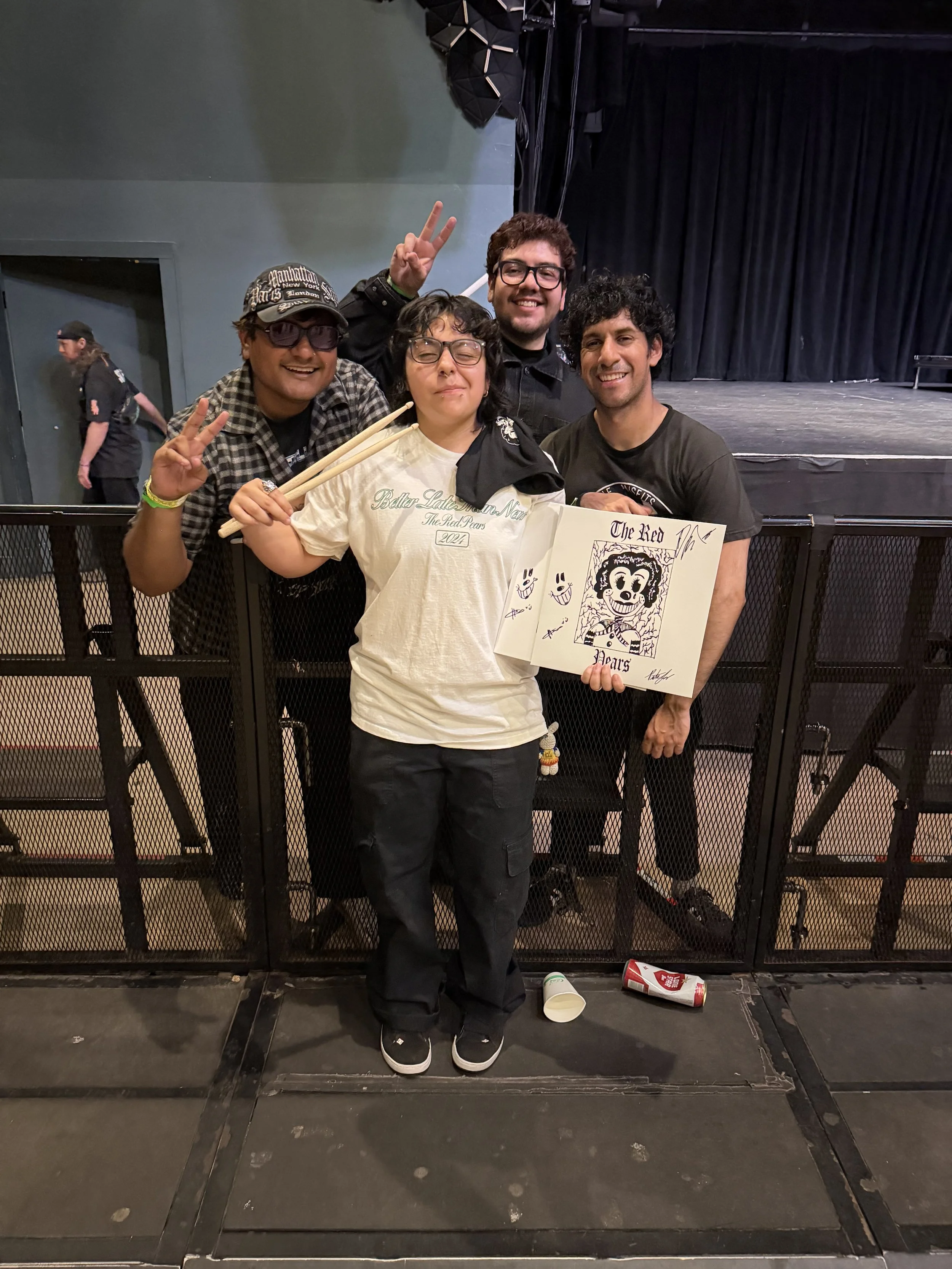
The Red Pears hold a special place in my heart because they are the only constant through the flux of Austin, the end of a relationship, and the weight of my own expectations. My love for them has regrown into something far more complex than the simple passion of an eighth grader. It is a love tempered by the knowledge that everything is temporary, and therefore, everyone is sacred.
The band taught me that while we can never be sure of the ending, there is a holy necessity in the journey. We bring everything we have to the table, even when the table isn’t there, and we keep sharing our songs — not because we are guaranteed they will stay, but because the act of giving is the only thing that makes the vast uncertainty of existence feel like home. Beyond just being a listener for years on end, I have found an intangible sanctuary that has grown with me and become an engraved piece of media that’s shared in my connection, referenced in my memories and wisdom of what's to come.