Jane Remover and Music Fandom in the Digital Era
The career of Jane Remover, one of the internet's most compelling young musicians, reveals how digital fanbases have transformed from supportive communities into suffocating forces threatening artistic freedom.
Written by Noah Keany
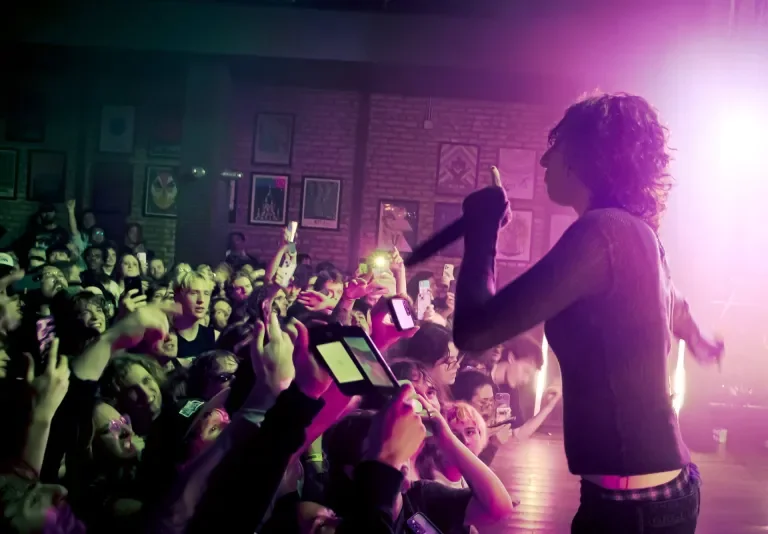
Photo courtesy of Ak Soares
A particular kind of exhaustion emerges from being loved loudly by the wrong people. Jane Remover, the New Jersey-born producer and vocalist whose entire artistic life has played out in the glow of a computer screen, understands this feeling better than most. At 22, they have built a cult following using little more than SoundCloud, X, and an instinct for melody that cuts through the most abrasive noise. But the same internet that made Jane Remover also made the conditions for a fandom that has, in their own words, scared them.
Jane's trajectory is inseparable from the digicore and hyperpop scenes that emerged online in the early 2020s. Under the name Leroy, they released Dariacore, a chaotic, sample-dense project that spread quickly through Discord servers and music forums before most listeners could even pin down what genre they were hearing. The 2021 album Frailty arrived under the Jane Remover name with woozy, hyper-pop textures draped over bedroom-pop vulnerability and a melodic instinct that turned impossible sounds into something undeniably catchy. The album found an audience fast, attached to the sound and eager for more.
The problem is that attachment, in the digital age, rarely stays pure. When Jane released Census Designated in 2023, the album was a deliberate artistic left turn toward abrasive and restless rock in a way that unsettled listeners who had fallen in love with Frailty's softer edges. The fan reaction was sharp. Rather than following Jane into new sonic territory, a significant portion of the audience pulled backward, demanding the artist stay within a box they had constructed for her without permission. The response was enough to leave a mark. In an interview with NME, Jane described the feeling plainly: "I felt I had to set the record straight." The critics and journalists who had once categorized them under "hyperpop" and "digicore" labels had already boxed them in, but now everyday-listeners were doing the same thing, and it stung.
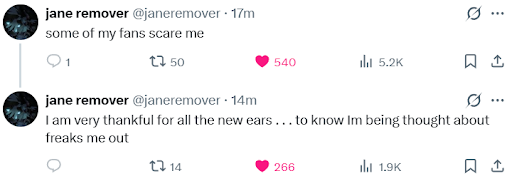
That sting permeates Jane's public presence. Their X has become something of a live document of what it looks like when an artist and their audience fundamentally misread each other. "Some of my fans scare me," they posted in one widely shared tweet. In another, they were more pointed: "I cant really say anything on here without a bunch of lil ass kids blindly following it and it annoys the hell out of me Frankly I am not talking to u and I never am. Where are the adults?" The raw frustration in that post, capital letters dropped and all, reads like someone who wanted to make art and found themselves beholden to voices beyond their own creative process.
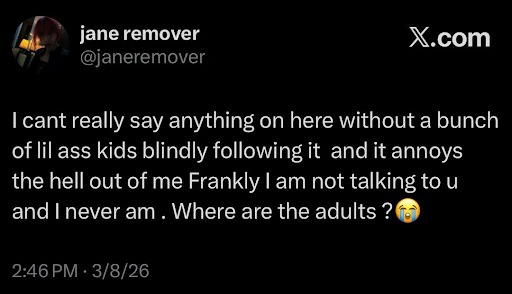
It is tempting to read those tweets as venting, the kind of thing any young person with a platform fires off and regrets, but Jane's discomfort with their fanbase is not just a mood. It is a recurring theme that has shaped actual creative decisions. The 2025 album Revengeseekerz arrived in part as a response to the loudest nostalgic voices in the fanbase, those who had never stopped asking for another Frailty. The album leaned into the energy fans wanted, but the title told the full story in that this was not a reconciliation. It was a transaction with a wink and a middle finger folded inside.
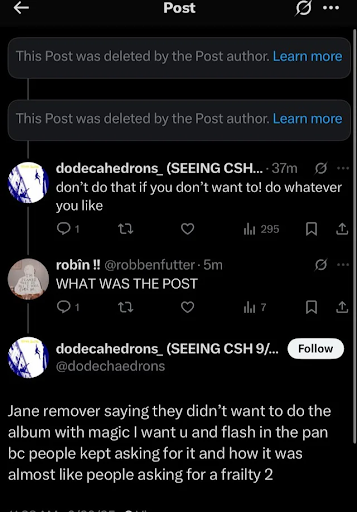
Jane captured this dynamic, noting that she did not want to record the album with tracks like "Magic I Want U" and "Flash in the Pan" because people kept asking for it, comparing the pressure to demands for a sequel to Frailty. The art that results from this kind of negotiation is still compelling. But the fact that it is a negotiation at all points to something gone sideways in the relationship between artist and audience.
Jane's peer underscores, in a 2023 interview with Office Magazine, articulated the tension in terms that apply just as cleanly to Jane's situation. When asked about the barrier between artist and fan, she said she believed there should always be "some kind of vessel to feed the communication between artists and fans," warning that without that mediating distance, things get murky and people abuse their power. She added that the album itself can function as that middleman, a structured object that filters the relationship. The problem for Jane is that their online presence, vivid and unfiltered on X, has collapsed that distance almost entirely. There is no vessel. There is just Jane, posting at midnight, and a fanbase that takes everything personally.
In a conversation with Anthony Fantano, Jane reflected on the specific character of an internet-based music career. "The fans are all really internet-y," they said, describing the gap between how fandom feels online versus at a live show. "Obviously, you feel the love when you go to the shows, and it's like, this is actually real. But then it's like, you can go online and it's like, oh my God, this is crazy." That dissonance is not unique to Jane, but it is uniquely concentrated for artists who built their audience entirely through social media. The shows are real. The X replies are also real. But they feel like they exist in different dimensions, and navigating between them is its own kind of labor.
There is also a more personal layer complicating the picture. In the same interview with NME, Jane acknowledged the contradiction at the heart of their career: "Being a famous musician, it's all I ever wanted growing up. I have a cult following, and it's definitely intense. I don't hate my fans, but it doesn't take a genius to know that something is wrong." Something “is wrong” not because the fans are entirely malicious, but because the structure of internet fandom has created conditions in which admiration festers as a desire for ownership. Listeners who grew up on Frailty believe, on some level, that their emotional investment entitles them to a version of Jane Remover that stays recognizable to them. The artist's own growth becomes an inconvenience.
Jane has posted about this directly, expressing their frustrations with critics and fans: "I used to get so pissed when journalists and critics put me in a box then everyday listeners started putting me in another box ... But in the same breath I haaaate 'fanbase talk.'" Jane does not want to reduce their relationship with listeners to a discourse about fandom, but the discourse keeps finding them because the behavior keeps happening.
On the Well Well Well Show, Jane made a blunt observation that deserves more attention than it got: "This is every fanbase. There is no good fanbase." Coming from someone who started out as a fan themselves, the statement carries unusual weight. It is not cynicism for its own sake. It is the conclusion of someone who has watched the machine run from both sides and found it broken regardless of who is inside it.
In a Vogue interview discussing Revengeseekerz, Jane described their creative process being born from total emotional saturation: "There are times where I'm mad at literally everyone. I'm mad at my fans and my contemporaries and I'm mad at the people in my life ... I feel like this album is a result of bottling everything up, it's a release." Jane Remover does not explode and instead channels the anger that might otherwise corrode their public persona into something that their audience will then attach itself to with even greater intensity, generating more pressure, which generates more bottling.
What Jane Remover's career makes visible is a problem that will only grow more acute as new artists come up entirely through social media. When a musician has no press cycle buffer, no label apparatus keeping fans at arm's length and no established persona protecting the actual person underneath, the audience fills those gaps with their own projections. They fall in love with a version of the artist they helped create. When the artist grows beyond that version, the audience feels betrayed. And the artist, watching this happen in real time on their phone, has to decide how much of their creative life they are willing to sacrifice to manage other people's feelings about who they used to be.
Jane Remover has not quit, despite telling their manager once a week that they intend to, per the High Snobiety interview. They are still making music, still posting, still navigating the whole impossible structure. But the fact that quitting is a recurring thought reveals something true about what the internet has built around young artists: a fandom that loves loudly and listens poorly, that wants the music and the musician on its own terms and calls that love. Jane Remover is a case study in why fans must move back toward understanding that musicians are opening the door into their self expression for us to consume, not for us to mold under our own terms.