
Interview: Study Break’s Impending Graduation
The local indie-rock quartet sat down with Afterglow to discuss the band’s rapid trajectory, reminisce on their backyard performances, and contemplate the group’s future beyond their college careers.
Written by Valeria Mota
Photos by McKenna Sefcik
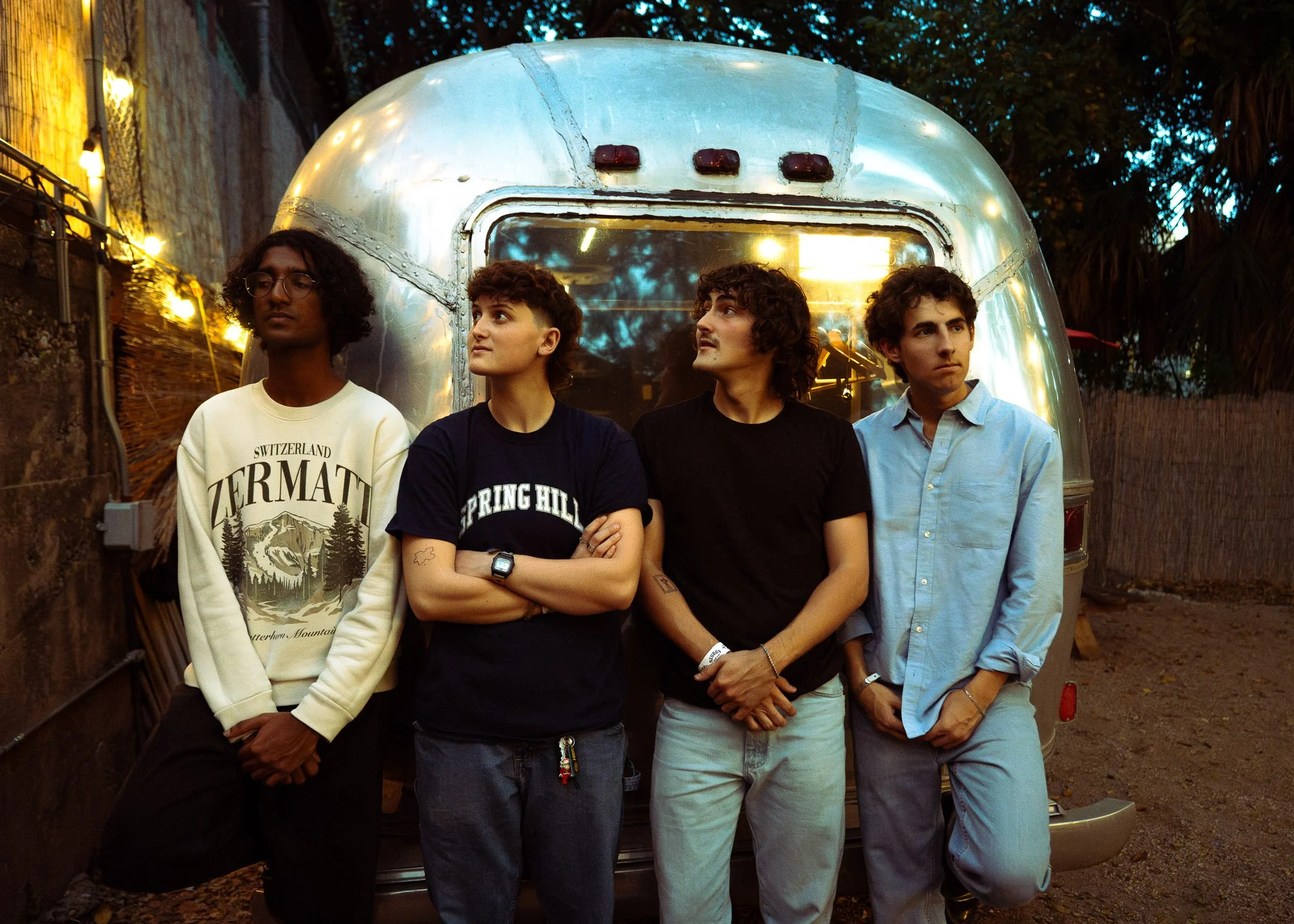
In UT Austin’s West Campus music scene, indie band Study Break has become a staple in the past school year. What began as a literal “study break” for the student band quickly transformed into a creative outlet, allowing them to chase their professional dreams. While the end of their college eras looms, vocalist Nevin Varghese, drummer Layton Thacker, guitarist AB Brown and guitarist Max Kinser examine the band’s rise in the UT music scene while weighing the possibilities of continuing post-grad.
Afterglow: How does being a UT student actively shape the way you write and present yourselves as a band; not just the name, but the whole vibe?
Nevin Varghese (vocals and bass): We have a desire to connect with others, especially UT students and UT student musicians.
Layton Thacker (drums): We’re surrounded by so many people that it’s easier to open up and self-disclose things that we care about and things that we’d typically keep to ourselves when we’re in such a large pool of people. Being a student is obviously us focusing on learning a lot of the time. Part of writing music for us is learning about ourselves, that self-discovery piece guides a lot of the music we put out and [make] some of our best memories as a band.
AB Brown (guitar): I think without being UT students there is no band. We all found each other through UT, and our progress is in large part due to the support from venues across West Campus and UT itself. I think that UT has allowed us the freedom to create and perform knowing that we have a whole community of fans and other musicians willing and eager to support us.
Your EP, Eastern Approaches, came out just a few months ago. Now that it's had time to live in the world, how do you feel about it looking back?
Varghese: Even as it was coming out, months after we recorded and promoted it, we had a different approach to music and exposure to the music scene we didn’t have when we wrote it. There was some naivety in concern for the depth, song structure and just fundamental things about the music. We were very young to music and to writing, to playing and being in a band. All of these things, when I look back, aren't the best music. The stuff we’ve written since then, I’m a lot more proud of. I’m like, this is music that’s a lot more complex and I want to make. But the memories of the feelings and the process of writing it and recording it in the studio, it feels like looking back on childhood memories of, like, that’s so sweet. I really appreciate, even if it wasn’t to our benefit at all times, how care-free we were about it. It felt like a change of pace from the stress of work and school. We could do it on our own however we wanted.
Thacker: I’m extremely self-critical … I never want to be bad at anything, and I found that when it comes to music as a creative outlet that has not changed. So when we wrote Eastern Approaches, at the time I thought I was doing something really cool that I’d never done before, which is true, but even at the time I was thinking “this isn’t the best,” like, I can do better. Even when it came out, I was excited, but just weeks [later] I already knew that we could do better, even when playing live shows, in front of people, which we hadn’t done before. A year on from then, we’ve gotten so much better at writing, performances, and skill in general that I think Eastern Approaches is not indicative of who we are now. It was a good freshman project, but it was more of a “dip our toes in the water” kind of thing, instead of what we can actually do. Now, I’m more excited to show people what we can actually do.
Brown: I joined the band after the other three members had written and created the EP. When I think of the EP, I think of how impressive it was for those three, completely new to their instruments and songwriting, to display so much passion for writing and recording the EP. It’s one thing to say you want to record and release something, it’s another to actually make it happen. I think joining only propelled that passion for the four of us. I obviously can’t speak for how writing and recording the EP was for them, but what I can say now is that all four of us offer so much when it comes to songwriting. I’ve been writing and recording songs on my own for years, but the collaborative aspect of Study Break has brought feelings of excitement towards music that I haven’t ever felt before. It’s truly electric when we write together. I think the EP was what they needed to get the overall foundation and experience of writing and recording, and now with the four of us together we can continue to create meaningful music that only gets better.
What was the production and writing process for Eastern Approaches like?
Varghese: For writing, me, Layton, and Max would sit in Torre [apartments] and typically we’d have something that was personal, emotional, or worth telling. We’d start with that idea, and then our process kind of switched between different songs. Sometimes we’d have chords or a riff that we liked, but a lot of the time we’d have lyrics we wanted and apply those lyrics to different strong structures. I know for me, I drew a lot of inspiration from songs that had a lot of bass lines that I liked, like singing lessons was my take on a Mac DeMarco bass line. We all took that approach when we were writing, like all of us have unique music tastes that found their way into the music we were writing. For recording and production, we rented out time at East Side Studios with a producer that Max had worked with before. So two days in July, we went in and recorded five songs, which was a lot of work and honestly kind of scary. It was the first time I felt like I needed to play the songs “right” as opposed to just playing in a room together. In there we recorded everything live first which we cared really deeply about. The foundation is us playing all live versions, and we went back in and added piano or guitar parts. The producer handled the production as well, we just told him what we wanted and he worked his magic.
Thacker: For me, the writing process was entirely new. I’m a journalism major, so my entire school education has been about writing, but writing creatively was extremely scary. I didn’t realize how vulnerable someone has to be to write a personal or involved song. Sitting down with Nevin and Max in our living room and putting together these songs was so uncharted, but at the same time so engaging. I was learning how to play my instrument as they were, but also learning how to talk honestly and openly about how I felt. Through that, I think we learned how to write decent lyrics to songs that were fun and good to listen to. Retrospectively, the production process we might have rushed a little bit. We ended up recording at a studio in Austin, which was an awesome experience, but maybe a little early. We hadn’t played in front of people at a live show yet, so I think we kind of went in without the foundation you need to be able to do that. It wasn’t easy; [we recorded] over two days, it was very extensive, a lot more than I thought it was going to be. It was extremely fun, I would do it again in a heartbeat even if we went in without a true understanding of what we wanted. At the same time, the production process was really cool. Recording it live, hearing our instruments, being able to go back in and edit takes and know what we did or didn’t want, we really felt like “rock stars.” That sounds really dumb, but it was really cool. Doing it with my best friends was a great part too. I felt no judgment and I wasn’t afraid because I knew everyone was focused on collaboration and following every idea through the end. Then the EP coming out was great too; my mom added “Tough Cookie” to her phone and listens to it every time it comes on her car radio.
The track “Sunspots" opens with a bird sound recorded at Pease Park. How intentional were you about grounding the EP in Austin specifically?
Varghese: That was a very intentional choice. We [talked] at one point about how bands always put voicemail recordings in songs … I really like when they do that, it’s fun. So we had gone through our voice memos that day and Layton had a recording from Pease Park, and we felt it really encapsulated a lot of the things that defined where we are and who we wanted to be. The whole point of the EP was “who are we right now and what can we create,” and grounding that in the environment around us. Layton had this before the EP and it was very authentic. It felt like a great approach to the music and how we wanted to present ourselves. We were able to EQ the memo and cut out the construction sounds and just have the birds, which I enjoyed in the production process. I liked what it represented when it was the first sound people would hear from us, something that we didn’t have to sit down and manually create but instead something we naturally had.
Thacker: As students at UT, which bases itself around Austin, we were enthralled with the idea of being in a city that was so cool. Personally, I knew that my first two years here I really dug into that idea of like, finding myself in this city. That sounds cliché, but during that transition from high school to college I needed something to base that change around. I met some of my best friends because of Austin, and I really appreciate what this city has done for me as a young adult. I remember running and passing through Pease Park and hearing the noise of the birds, dogs barking, and families laughing. That park has been a staple of my stay here. I ended up recording that voice memo for a journalism project I was working on months prior, but when we were recording the EP we really wanted something that was grounded. It’s hard to do that when the songs are so personal, but the voice memo acted as a centerpiece of something we could all connect on, there was some relationship we all had with it. I think part of why we had included that is [that] we had reserved this production space, so we thought of everything we’d ever want to try and go for it. One of those things was “let’s include a voice memo,” because some of the bands we listen to also used voice memos. We were kind of copying, or imitating, the art we were trying to make since we were so new to the creation process.
Max Kinser (guitar): We were quite intentional. All of us are from four different places, but Austin is the place where we all met. So Austin is not just “where we started Study Break,” but it’s also a very central part of all of our friendships with one another. All of these songs are memories that we’ve made at school here in Austin, so getting to commemorate it even in little ways is really meaningful.
“Study Break" is a very specific, college-coded name. Was that branding intentional from the start, or did it just fit naturally?
Varghese: Honestly, I think we all worked on the assumption that Study Break was a placeholder name. Something a college band would call itself, ‘cause obviously it’s related to college. It’s very tongue-and-cheek, and it almost felt like an inside joke to us as we started to write music. However, as a place holder, we never found something to take its place. As it came time to book shows and start marketing and publicizing ourselves, we stuck with the name, and so, to your question, I think the best answer is that it just fits naturally. We didn’t feel a need to change the branding or the name when we were starting out which kind of gets us to where we are now.
Thacker: I was not in the room when they chose Study Break as the name. I walked in and Study Break was the name they decided on, and I was under the assumption that it was a placeholder name that we’d keep until we found something else that stuck. As we started playing more and writing more and hanging out, the whole idea of “changing the name” faded because it didn’t feel that important. The focus was much more on playing and writing than it was about branding. When we started playing live shows and getting a live audience that was willing to listen, the idea of changing the name became a non-issue. It is very college-coded, because we are all obviously college students, and we’re not looking too far into the future. Now, it almost has a nostalgic feel to it. As Study Break has become a more tangible and real experience, the idea of being taken seriously has populated my thoughts more. Especially now, as we’ve garnered our own reputation and played shows in venues that we’ve always dreamed of, it feels “real” finally, and that is a little scary.
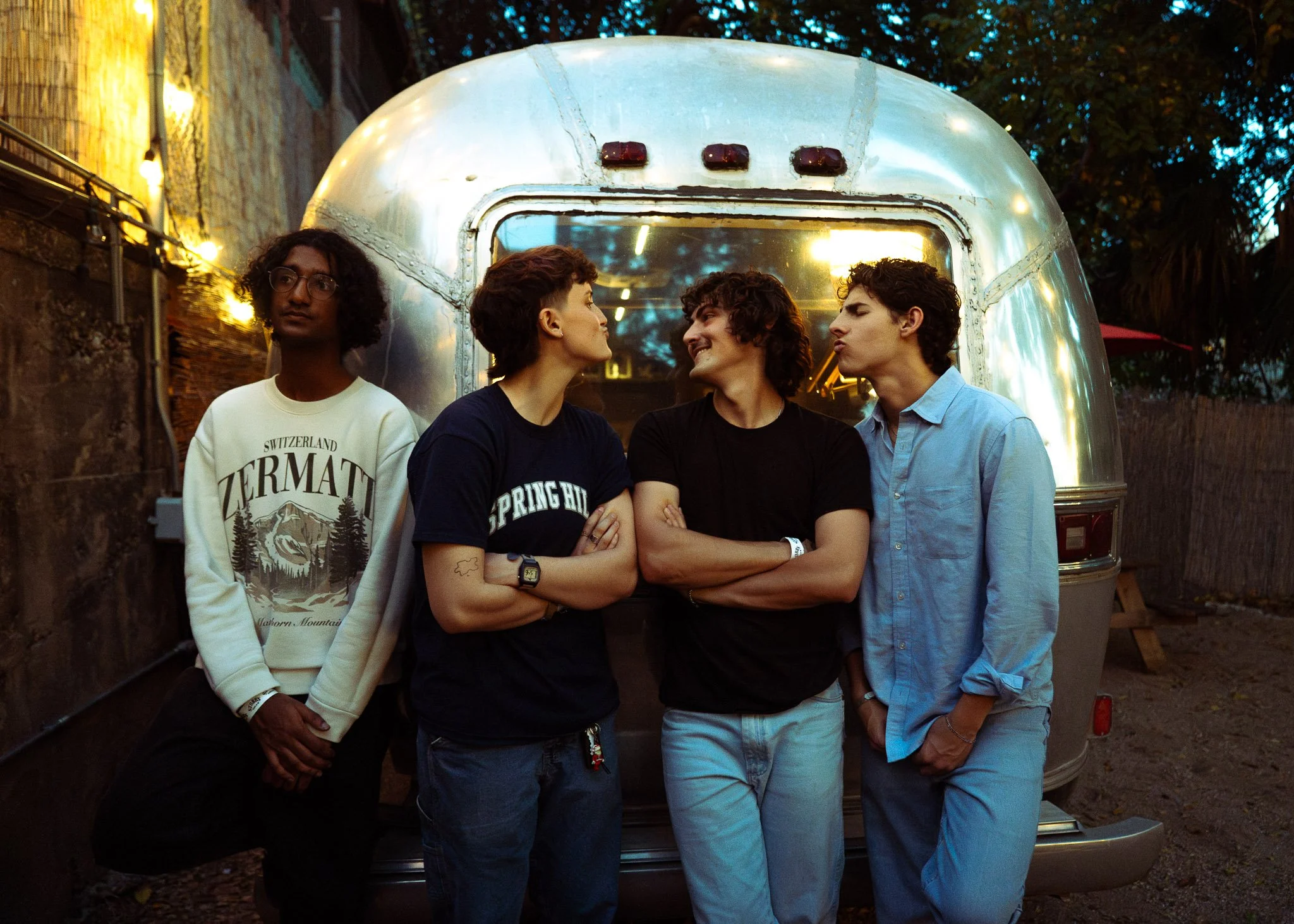
What do you think about college graduation as a band? Does the band evolve, or will the college aesthetic still be present?
Varghese: I think honestly the music we’re writing now, especially with the skills and knowledge we’ve developed and played shows, and just gotten better at music, I don’t know how much “college” fits into the music we’re writing and making. I think we’ve found that recently it’s a lot more important to really match not just the music we listen to, but the music we like playing. I can speak for myself that the music I like playing is heavier and louder than the sounds that were on the EP. So with that, I think that the best answer is that the band is evolving and will continue to evolve, because I don't think we really define ourselves by any aesthetic or really any genre. I don’t think we're very strict on guidelines. The focus has always been on making what we want to make and playing what we want to play. So with college graduation, which comes with a lot of questions on where we are and what that looks like, outside of that I think we will be able to continue to evolve because of this belief in being authentic to ourselves.
Thacker: I’ve thought about graduation a lot, and not in the sense of music but more in the sense of my career. I don’t feel at all that our music is centered around the “college experience.” I think we’ve strived to make music that centers on our experience as people rather than students. I know we’ll continue to evolve in our creative process, because we’ve already done that in the past year. College has never once been a factor in the kind of art that we make. I will say, college has fostered situations that have allowed for evolution, but the way we make music is independent of where we’re at in our careers. It’s more based on where we’re at as people. A lot of our music, as most music is, comes from a place of emotional growth, and I think college is a great way to fast-track that growth as it brings it to the forefront. My hope is that we’ll continue to make things that are true to us, and that we believe in, and that we honestly truly enjoy and that we’d want to hear.
Brown: When we perform and make music, we are entirely focused on what we enjoy making rather than trying to fit into a certain aesthetic or making music for a certain audience. I think we’re constantly evolving whether we see it or not. I think I’ve grown more in the past year than I have in the previous 18 years, and I get the privilege of experiencing that growth in the form of music with this band. I mean, I can genuinely see and hear the growth of our band, and I think that comes from our shared experiences and progression of our relationships more than it has to do with being in college.
Do you see yourselves continuing as a band after UT? Is that even a conversation you've had seriously, or is it more "let's see where this goes"?
Varghese: I quote said “we’ll see what happens" when we talk about any of that very long term conversation. Not because I want to avoid the conversations, but because all of us agree that it really depends where we’re at both individually and as a band when it comes time to make those decisions. I think all of us do have an innate desire to keep pursuing this and make things that people can connect to, but none of us are like dropping out or anything super serious like that because we’re all very grounded and realistic, which I don’t think is a bad thing at all. When me, Layton and Max graduate next spring, we’ll see where we’re at, but I’m pretty sure most of us have plans to stay in Austin following that, so I don’t see why we wouldn’t adapt ourselves as a band to where we’re at.
Thacker: I was never a very musical person, I only learned how to play an instrument because we wanted to make a band. I remember my freshman year seeing West 22nd play at Ballroom and thinking that was the coolest thing I’d ever seen. Knowing that UT students could make themselves through creativity and doing what they love drove me to say yes to taking on a risk like playing music. When I think about post-grad now, I’m a little conflicted on the idea of pursuing a traditional career or trying to follow this creative path that’s been set for me. I think that, as of now, a lot of us — if not all of us — plan to stay in Austin post-grad, and if that’s the case I would love to see this continue. I find a creative outlet in this that I would never find anywhere else, and I can’t put a price on that. Every show we play, I get a little more hopeful that this will continue, because I love getting to spend time with the people I care about making the things I want to make, and seeing that come to life.
Brown: Honestly, I think the four of us try our best to focus on the present. Our main focus is making music we genuinely enjoy and performing shows that we can look back on and feel accomplished as a band. I’m a year younger than the rest of the band, so obviously that is a factor we may have to consider in the future, but for now the future is undecided. Who knows? Maybe we have the opportunity to really make it big and we’ll have to make decisions based on that. It is truly unpredictable, so I think we all prioritize making the most of the time we do have together instead of picturing how it may or may not end.
You went from backyard shows to Stubb's Indoor in just a few months. What did that progression actually feel like?
Varghese: I genuinely still can’t totally register it. My favorite concerts, my top three, have all been at Stubb’s outdoors. It carries a lot of weight to me, and I have a lot of memories attached to it. It’s an important place to me. I can still remember very vividly the feeling I felt standing on that outdoor stage as we walked to the green room that my favorite artists have also sat in. Feeling so fulfilled and at the same time this intense hunger for this to not be it. I didn’t want that to be the last time I was on that stage, and I refuse to think of it as a once in a lifetime experience, so I think we are so capable of doing that again. The progression itself I think drew on a lot of our strengths. A lot of us have good connections and people skills that let us grow as a band and as a brand. My hope is that we can continue to do what we're good at.
Thacker: That first backyard show we played I was so nervous that I couldn’t stop shaking, and then we played it and people cheered. And then we played another one and another one and so on. Then, within 3-4 months I was feeling that same way stepping onto the Stubb’s Indoors stage. I remember sitting on my little stool and looking up into the lights and seeing people in the audience, and thinking that Willie Nelson had played here, Waylon Jennings had played here, and now we were playing here. Not to say we’re on their level of course, but the fact that we got to experience that in such a short amount of time was so incredible and so special. Throughout that entire semester, I’ll speak for myself, I had a big struggle with imposter syndrome. I couldn’t really believe that we were there really based on our own merit, and after finishing our set, and talking to all my friends and seeing the other performers, I felt so fulfilled. I think the progression was mostly luck, and a good amount of hard work put in on our parts to make it to that point. I recognize that that was a very special experience, but just like Nevin, I believe it won’t be the last time, and I look forward to hopefully stepping up there again as a much better artist and a much better performer.
Brown: Honestly, it was surreal. I have always confidently said that my favorite thing to do is get up on a stage and sing. I had never really had the opportunity to do it though until that first backyard show. That show was one of the most exciting experiences of my entire life. I was finally doing what I had always wanted to do, so you can imagine how Stubb’s felt. Even if it was just the indoor stage, I couldn’t believe that I was standing in the same green room where my favorite bands of all time had played. I mean, I grew up in Austin going to shows at Stubb’s. I remember saying it was the best day of my life over and over again. However, like Nevin said, it was also combined with the excitement of what we could become. Essentially, I am following my lifelong dream because of this band, and I could not be more grateful.
Austin has such a saturated live music scene. How do you carve out space as a student band among professionals who've been doing this for years?
Varghese: I don’t think it was a conscious decision that we made specifically, but I think we’ve made very good connections with organizations at UT as well as other musicians and their communities. We’re in a spot where we can mutually rely on each other to put on a show and draw in an audience that is going to care about the show and everyone involved in it. I think that human aspect is what often gets lost in modern music promotion, and I really appreciate that a lot of what makes us as a band is the connection we formed with the people that are physically around us.
Thacker: I have nothing but respect for professional musicians. Trying to consistently perform at such a creative level has proven to be so difficult, and I really admire people that take that on as a career. However, I think that as students who have jobs, course load, and other responsibilities outside of music, it allows us a new or unique perspective on creating that is sometimes underrepresented in the music scene. I do believe that we’ve been able to foster such a loving and friendly community that has allowed us the opportunities we’ve been given. I feel like that’s hard to do without the community that college has allotted us. Personally, I feel like we are still trying to carve out that niche. Austin truly is the best place to dive into music, and because of that, we’ve been given so many chances that other places might not have done the same. I feel like we’ve been able to form relationships with professional musicians and music professionals in general that otherwise would not have been possible in other cities.
Who shows up to your shows? Mostly UT students, or are you starting to pull a wider crowd?
Varghese: A lot of the shows we’ve played have been connected to different student orgs, and it’s been really fun seeing these different communities. Ultimately, that is our biggest audience, our biggest draw. We are a student band at UT, so UT students are the people that are going to show up, which has been really fun because it makes it that much easier to connect with the audience and feel like we're doing something that people are going to take note of. At the same time, we are starting to get asked to play shows in other cities like San Marcos or Lubbock, and my hope is that they aren’t one-off shows and that we are able to draw in a wider audience.
Thacker: Our shows mostly consist of UT students and that is completely expected. When we started this whole thing, we would never get to a point where people who didn’t know who we are would care about us or what we’re doing, but now even within UT we are getting asked to play shows from complete strangers, and that’s really exciting. Like Nevin mentioned, we’ve been reached out to by different schools around Texas who want us to play a show and who have seen our stuff, primarily through social media, and that’s really crazy to think about. Even on our Instagram, we’ll have people who have never met any of us who like what we do, and that is exciting.
If Study Break turned out to be a college era thing, would that feel like enough? Or does all of this only feel worth it if it goes beyond UT?
Varghese: When we were just starting out, and this theme has remained constant throughout all our conversations we’ve had about who we are and what we want to do, we’ve said ultimately this needs to be fun and we need to play live shows for people. If it comes to a point where our professional or personal lives are not congruent with remaining in this creative landscape, my only hope is that we would be able to look back at if fondly and end it in a place where we are confidently able to say we’re proud of what this was and what it represents and the relationships we made. If it goes beyond UT, which I’m hoping for and that’s the goal of any band, I hope I never take that for granted because where we’re at now, that is ultimately the goal even if it seems miles away from where we’re at. So either way, I never want to lose sight of the original intention of this being something that helped us break away from the monotony and the lack of purpose I was feeling before we started this project.
Thacker: Part of me wants to say yes, but part of me wants to say no. When we first started this, I didn’t really see it going beyond playing a few backyard shows, and just having fun. Now, as we’ve developed more of a passion for it, I really hope we can continue this whole thing as a group. I really love what it’s given me, and I really can’t put a price on how valuable I believe it is, and I would love to keep doing it beyond where it’s at now. I feel like, now, I see Study Break as beyond UT, whereas before I just thought of it as a college band. I’ve had this idea for a while now, where one day 30 years in the future I tell my kids I was in a college band and they laugh and they call me old and forget I said anything, but recently I’ve been wondering if I can tell them it was more than just a dream we all shared for a couple months, that it was something important.