
Dance in the Desert: The Story of Mali’s Festival in the Desert
Between 2002 and 2012, the Sahara Desert was host to one of the most unique music festival experiences. The Festival in the Desert combined Tuareg cultural traditions and the sound of desert blues genre in the vast sand dunes of the area, before regional instability and violence forced the music to go silent.
Written by Declan Garvey
Illustrated by Jenya Ratanjee
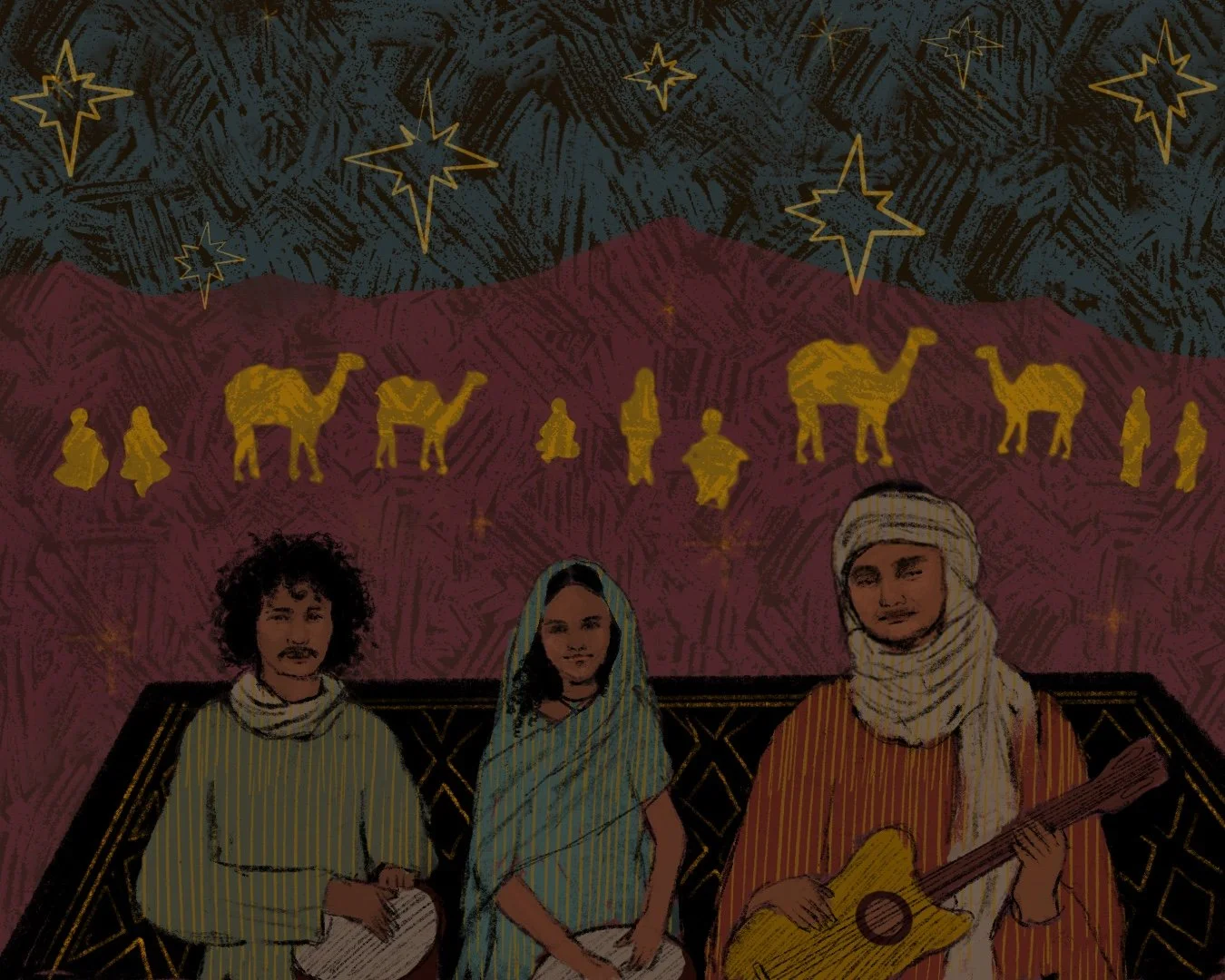
No two music festivals are the same. Austin City Limits rolls into Zilker Park in the fall with its huge stages, grandiose production value, and strict 10 p.m. noise curfew. Levitation brings alt rock to the Palmer Events Center, with entertaining lights and so many tattoos that you wouldn’t be amiss to think that they had tattoo parlors operating in the venue. Montreux Jazz Festival takes place along the shores of Lake Geneva, creating one of the most scenic concert-going experiences. Not to mention the massive EDM festivals in Europe, small local festivals, and everything in between.
That being said, the short-lived Festival in the Desert was arguably one of the most unique festival-going experiences. It included a fusion of rich Tuareg cultural traditions, West African music, and world-renowned artists displaying the highest levels of musical technique. A music festival that took place in a truly remote and hostile environment, the Festival in the Desert materialized amongst the expansive golden sand dunes of the Sahara Desert. From 2001 to 2012 each January, just for a few short days, a stage would be erected in the dunes, and the sounds of music would fill the vast, endless sea of sand. An experience unlike any other, the rapidly departing festival provided one of the most distinctive festival-going experiences in the international music scene.
The desert blues genre is the primary style of music played at the event, combining elements of blues and rock, with lyrics inspired by traditional poetry of the region and indigenous instruments, such as the ngoni and the calabash drum. Twangy guitar full of intricate sequences of hammer ons and pull offs, a string-instrument playing technique in which strings are quickly pressed down on or pulled off to add in extra notes, forms the basis of the sound. Percussion is often added through the unique calabash, an instrument made from the dried gourd of the calabash plant, creating a distinct tapping sound. Albums such as Ali and Toumani, by West African music legends Ali Farka Touré and Toumani Diabaté, feature masterful work on the Kora, an intricate and immensely complex harp-like instrument which highlights the more acoustic side of the genre. Amadou et Mariam’s Je Pense A Toi is a solid introduction to the electric, guitar-oriented side of the genre, combining strings, horns, the calabash, and drum kits, illuminating the dynamic nature of the genre. Mdou Moctar’s Ilana (The Creator) embodies the psychedelic and distorted side of the genre with long and intricate guitar solos. These are just a few sections of the extensive and expansive genre.
As one might gather from the name, the Festival in the Desert took place in a desert. This practice, although unique, is not new, with larger festivals, such as Burning Man, taking place 100 miles outside of Reno Nevada, in the black rock desert. The Festival in the Desert originally started at a location so extreme and inaccessible that they were forced to move it in response. The first iteration of the Festival in the Desert took place in 2001 in the small and remote village of Essekane, Mali. Located around 40 miles west of Timbuktu, the festival sat deep in the Sahara, the world's largest hot desert. Infrastructure in Essakane is minimal, reflective of a country that ranks amongst the bottom 15 of the world's lowest GDP per capita globally. Because infrastructure is nearly non-existent, the journey is particularly arduous. Yet at the end of the treacherous journey, rising out of the sea of sand, is a stage and a series of tents that make up the festival. However, the remote and isolated nature of the location was ultimately not the festival’s greatest challenge.
This vast and empty region of the world is highly unstable and dangerous. Mali, like many once European colonies in Africa, has borders created by foreigners with indifference towards the actual demographic makeup of the area. Violent political instability caused by divisive borders has existed within Mali since it gained its independence in 1960. One of the many groups impacted by these borders is the Tuaregs, an ethnic group whose culture is defined by their nomadic herder roots, a practice that has become increasingly difficult to maintain within expanding travel restrictions and increasing desertification, reducing the already scarce resources in the region. The Tuaregs have taken up arms as a result, with numerous rebellions and ongoing hostility against the current Malian regime. Mali has also suffered greatly under the rise of Islamic extremism and jihadist insurgents, with Al-Qaeda’s affiliates leading a sustained rebellion throughout the region for over a decade now. A weak and ineffective central government damaged by numerous coup d’états is unable to sufficiently respond to these challenges. The north of Mali, where the festival took place, has become a hotbed for much of this instability. Due to the inaccessible location and insecurity, the festival was forced to move closer to Timbuktu.
One of the key elements of the Festival in the Desert was its incorporation of Tuareg culture. The Tuaregs have a rich history of hosting festivals and celebrations in the desert. The annual Sebiba Festival marks a multi-millennium-long peace treaty between two Tuareg tribes, with women singing traditional songs to the beat of the ganga, a traditional tambourine-like instrument, while men dressed as warriors dance to the tunes. The Festival in the Desert blended these traditions with Western music festival traditions to create a unique result. The elaborate outfits take the shape of the long and loose indigo dress robes of the region, camels for transport in place of cars, and the bright fluorescent tents taking the form of large canvas clothes secured by sticks dug into the sand. Photos of festival goers arriving on camels to the festival, donning the Tuareg’s colorful traditional robes, have become synonymous with the event.
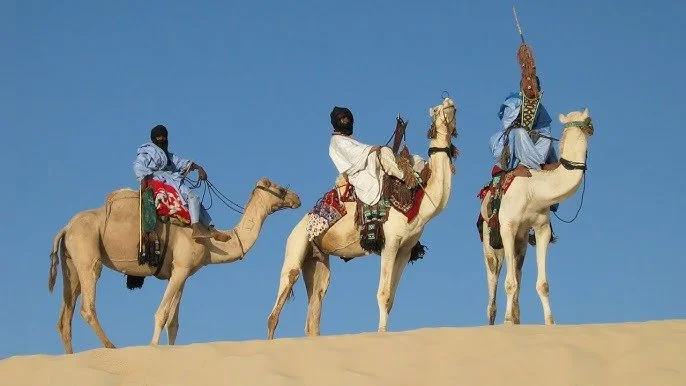
Photo Courtesy of Afropop Worldwide
The music at the festival also contributed to its uniqueness. The list of performers at the festival was primarily composed of West African musicians, many of them being some of the most well-known desert blues artists. One notable attendee was Tinariwen, a Tuareg band active during the Tuareg’s violent struggle for independence. Many of the band’s members actually served in combat. Their sound is defined by the region, lyrics of longing for their desert homeland are ever present amidst the rhythmic taps of the djembe drum and the calabash, with the drones of guitar throughout. Also present was the duo of Amadou et Miriam, a blind couple who blended the classic desert blues sounds with their favorite artists, such as the 20th century French singer Edith Piaf and the guitar work of Jimi Hendrix. Ali Farka Touré, one of the influential desert blues guitarists and multi-time Grammy award winner, who was dubbed the African John Lee Hooker, performed for the attendees. These are just a very brief overview of the numerous West African stars who graced the stage in the desert. However, there were numerous talented and celebrated Western artists who made appearances at the festival, including Bono of U2 and Robert Plant of Led Zeppelin.
The turbulent state of Mali made it impossible for the festival to continue, with the last iteration being held in 2012. This was one of the most tumultuous years in Malian history for a variety of reasons. January of 2012 marked the beginning of the Tuareg Rebellion, a conflict which would later spread to involve numerous Islamic extremist organizations. The various rebel factions took control of much of North Mali, where the festival once lived. In March of the same year, there was also a coup d’état, which destabilized the situation even more. With the festival organizers unable to guarantee the safety of the event, the music stopped.
Since then, Mali’s stability has yet to recover. Much of the country still lives in a state of violence and conflict, and the grand return of the Festival in the Desert seems extremely unlikely. The music scene in Mali has also suffered significantly, with threats of violence towards artists by extremist groups who control vast swathes of the country, forcing many to lay down their instruments out of fear. Increasing economic uncertainty within the country has also made the space financially unsustainable for many. Despite the festival’s limited lifespan, fans of the region's music scene and adventurous concert goers remember the event as a one of a kind festival-going experience thanks to its blend of noteworthy music and distinct Tuareg culture.