
红歌: “Red Songs” as Multilayered Propaganda in China
Rather than relics of history, China’s red songs, or songs with patriotic and political undertones, have continued to evolve and integrate themselves into Chinese society via classrooms, public spaces, and media platforms.
Illustrated by Giselle Barrera
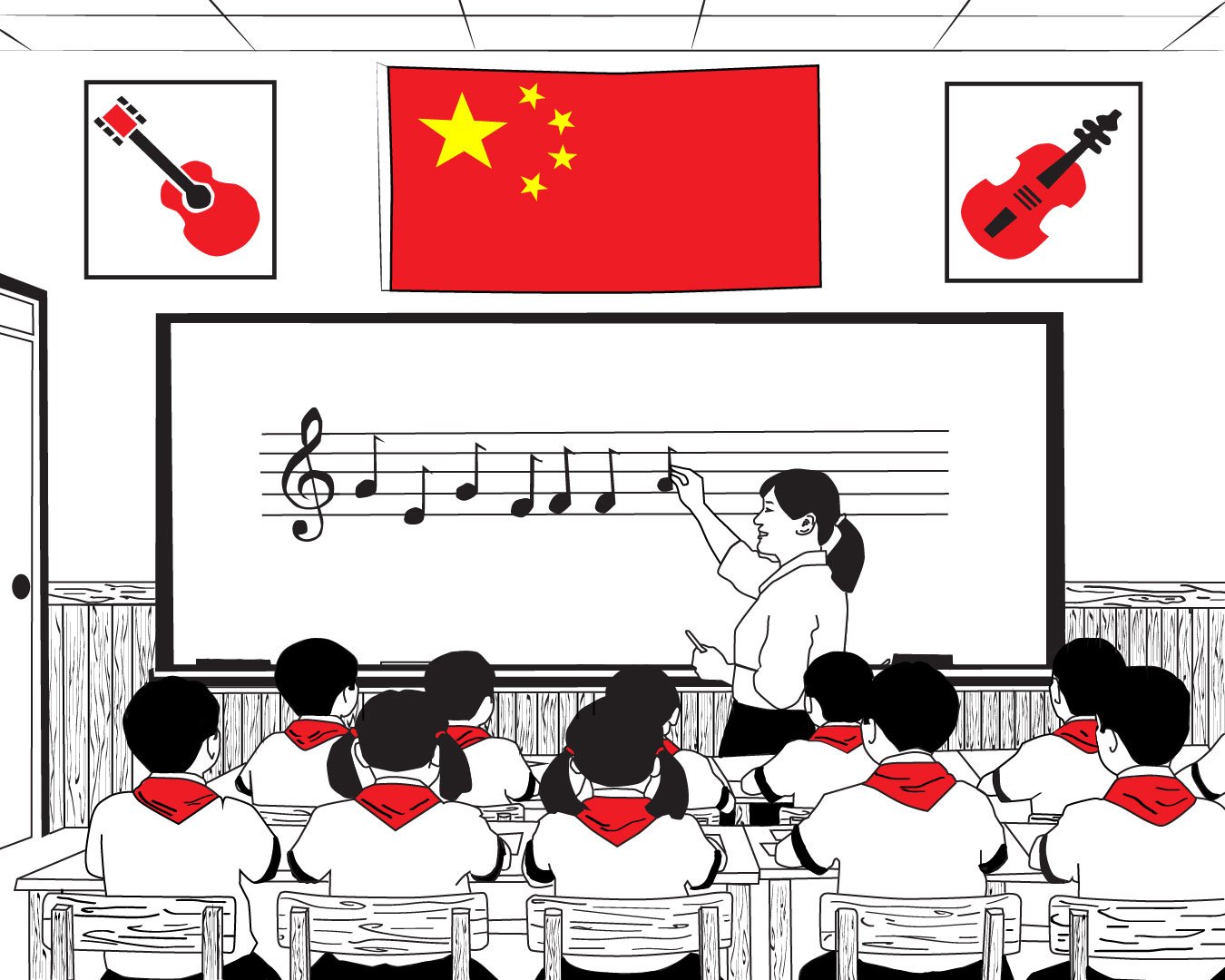
Art and propaganda have a deeply interwoven relationship throughout history and across all regions of the world. Political figures consistently employ various art forms to express state-sponsored ideologies. One example of this relationship is in China, where the Chinese Communist Party (CCP) employs music as a tool to praise socialism, the military, workers, and other core party values. When the CCP took control of China in 1949, patriotic and political songs — collectively known as “红歌 (“red songs”) — quickly became conventional popular music. However, when the nation opened its economy and social landscape to globalization under Deng Xiaoping in the late 1970s, Chinese popular music expanded in thematic explorations, venturing beyond the strict bounds of CCP-centric rhetoric. Red songs continue to manifest themselves throughout modern Chinese society as a propaganda tool through education, media/public space, and modern pop infrastructure.
The primary form of propaganda begins during early education. Currently, music classes are mandatory for all Chinese students between Grades 1-9. While the curriculum has undergone many transformations to modernize and reflect cultural relevance (such as the incorporation of Western, folk, and Taiwanese pop music), red songs remain a core component. Songs taught in music classrooms often contain explicit references to party ideologies, such as “今天是你的生日 中国” (“Happy Birthday, China”). Alternatively, the messaging may be more subtle, connecting relatable subjects to CCP-approved messaging. In “小燕子“ (“Little Sparrow”), the lyrics “今年这里更美丽 / 我们盖起了大工厂“ (“This year, it is even more beautiful here / We’ve built new factories”) positively connotate beauty with the progress of industrialization, a party-identified economic priority. Moreover, since China has 55 ethnic minorities and historically regionally rooted cultures, fostering a homogenous identity is a major government goal to ensure stability across its 1.4 billion population. As a result, the Chinese music curriculum also prioritizes the core value of unity. Regional tunes, such as “落水天” (“Rainy Day”) from the Canton region, are incorporated into nationwide music education. On one hand, this encourages inclusivity and inter-regional understanding; on the other hand, it implies that all cultural diversity must still fit under the larger umbrella of Chinese nationalism. To school-aged children, music is internalized as a moral compass and a cultural connector. It encourages a sense of belonging on multiple levels with conventional social values, shared national identity, and a close-knit unit with other children in the classroom. The implicit and explicit rhetoric of red songs can easily cement strong, politically aligned perspectives during and beyond a child’s formative years.
Red songs and their political messaging penetrate Chinese society well beyond the Grade 1-9 curriculum. Since the commercial music market became less regulated in the 1990s, the commercial music market saw an influx of imported foreign music and the rise of mainland private artists breaking into the mainstream. Still, officially-sanctioned musicians and their songs remain popular, in part due to government support. In CCP-sponsored media channels, which span from traditional television channels to social media, red songs are either the default choice of entertainment or used to enhance other propaganda vehicles like commercials. These songs also often fill public spaces, such as tourist attractions and plazas. While the choice to play red songs is sometimes state-sponsored, it is also often driven by individuals in these spaces. For instance, many older generations who participate in 广场舞 (square dancing, a setting where music is played out loud) select red songs because their musical tastes developed during a time when only state-sponsored music was available. With state sponsorship, red songs continue to fit modern music tastes and societal functions, simultaneously making their underlying state-sponsored ideologies more integrated into everyday life.
China’s mass media landscape and musical influence in cultural identity remain ever-evolving. Due to state censorship and large-scale bans of earlier decades, a mainland Chinese music scene was never developed, so Chinese-language music has long been dominated by Hong Kong and Taiwanese artists. Since these regions are not CCP-controlled, their music exports are more thematically unbounded and creatively liberal. As these songs flood into mainland China’s commercial music market, they sometimes come into indirect conflicts with the CCP if they promote what is deemed as corrupted social values. For instance, Anita Mui was a hugely successful musical act in China and the rest of the Chinese-speaking world, but her album “Bad Girl” was banned in the mainland due to its suggestive content. While China actively mitigates the potential danger of such music with active censorship, many implicit, “corrupted social values” may still slip through the cracks. Increasingly, however, mainland China has produced more artists of great commercial appeal in recent years, including the musical duo 凤凰传奇 (Phoenix Legend), who are also members of the People’s Liberation Army. This is largely due to the nation’s rising political prominence and economic wealth, enabling it to keep developing its maturing creative market and directly orchestrate the social values promoted in popular music. While mainland artists maintain great creative liberty, their music and reputation must be in accordance with CCP’s values. Otherwise, they may risk retaliation, which may include censorship ranging from temporary social media bans to a complete erasure of their physical and online presence. Examples include the 2020 ban on the song “我们的海口天空” (“Our Boundless Sky and Sea”) due to its connotations alluding to the widespread anti-government protests in Hong Kong.
On the other hand, the CCP also creates positive reinforcement mechanisms for ideological messaging by creating high-exposure platforms for artists. In these cases, participation is conditional on compliance. For instance, the Spring Festival Gala, a state-sponsored show that occurs annually on Chinese New Year, is the most-watched TV show in China. This event offers unparalleled commercial opportunities for artists, whether they are of mainland China origin or elsewhere. While the show features a diverse variety of performances, they often carry undertones of party-approved messages. For instance, the Hong Kong star Andy Lau sang alongside robot backup dancers at the 2021 Spring Festival Gala, highlighting the technological progress of China’s advanced manufacturing sector. Ultimately, artistic liberty in mainland Chinese pop culture is still exercised with guardrails. As a result, red songs and their propaganda messages are also taking on new forms, evolving to meet consumer demand and allowing the CCP to maintain its cultural soft power.
As music overlaps with China’s cultural and political fabric, politics seamlessly seep into people’s internalized cultural norms. The blurred lines between emotional resonance and CCP ideology make politics feel natural and inevitable. Importantly, this does not take away the merit of red songs – they can still be introspective, compelling, and well-produced. In fact, the musical quality is exactly what makes the strategy of music-as-propaganda effective — genuine musical enjoyment makes community building and emotional resonance all the more effortless.