
Wine and Cheese: Fleet Foxes and Cameron Winter
Looking to have an introspective fall? This unlikely pairing is a perfectly strange glass of oaky chardonnay and wheel of caramelized gouda for your melancholy nights.
Written by Caroline McConnico
Illustrated by Molly White
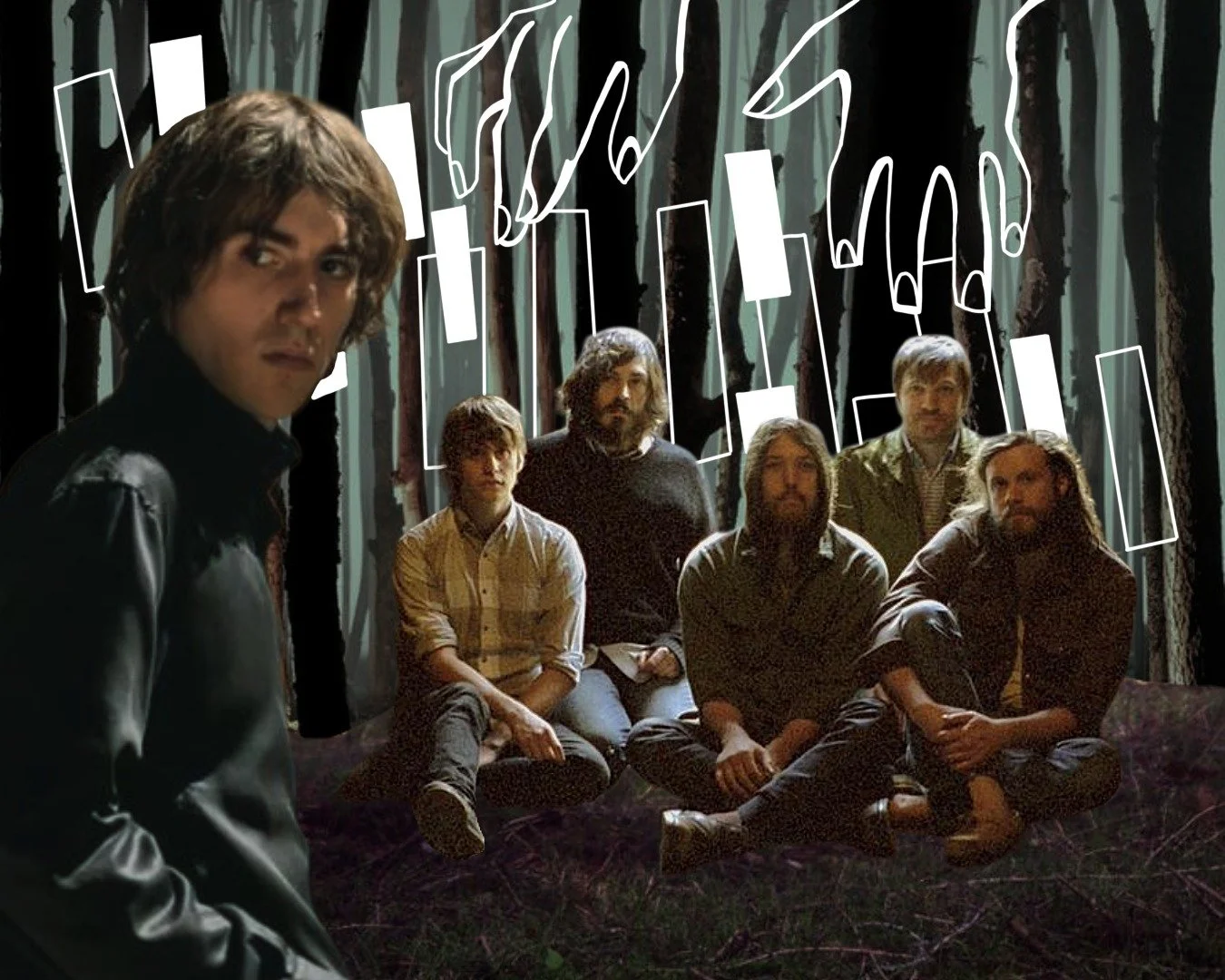
With the foreboding of fall and the bittersweet end of Halloween, autumn has more than settled into our bones. The sun sets earlier, and although Austin's air has yet to acquire a crispness, people are already pulling out their sweaters at the first sign of 65-degree weather.
The season, notorious for mid-semester anxiety and numbing derealization, is not without its charms — namely, the haunting melodies of artists who sound as though they embody autumn’s ochre essence. Fleet Foxes and Cameron Winter are two of these harvest handicrafters.
Though seemingly different, both musicians convey the spiritual ambiance of the season. Fleet Foxes create expansive, harmony-rich folk music that evokes natural landscapes and reflection. On the other hand, Winter's solo work feels more unpredictable, with unconventional melodies and lyrics that drift between surrealism and confession. Despite their contrasting sounds, Fleet Foxes and Cameron Winter share an almost religious approach to songwriting, using evocative vocals, poetic lyricism, and existential questioning to transform ordinary human experiences into something transcendent.
FLEET FOXES
A Seattle-based five-piece, Fleet Foxes are known for their 1970s folk-rock and Appalachian-inspired arrangements. Robin Pecknold (vocals, guitar) and Skyler Skjelset (guitar, mandolin) originally formed the group in high school. After graduation, the duo teamed up with local Seattle musicians and soon gained a massive following on MySpace.
What set the group apart was their indie-folk sound highlighted with a pastoral blend of voices. Taken together, the harmonies almost resemble a church choir delivering a powerful hymn. Beyond their lush vocals, the band used folk-heavy instruments like vintage kettledrums and the Baldwin Electric Harpsichord to bring an old-timey flavor to their modernly produced albums. This technique gave Fleet Foxes an intentionally timeless and organic aesthetic that the group has since held on to.
A lot of what Fleet Foxes are known for is writing songs that put the listener into nature. The authentic lyricism of Pecknold draws skies the color of a winter’s day, simultaneously cold as the snowy ground and warm as the fire back at the cabin. His songwriting combines imagery of the wilderness to answer existential questions about family and growing up. Pecknold often calls out family members or fallen heroes in his songs, grounding the listener and conveying his intense interpersonal focus. In a 2022 Rolling Stone article, Pecknold said he doesn’t feel his taste in lyrics has changed much. He describes his method as discovering songs rather than writing them. “I’m not sure if we really change as we get older,” he said. “Maybe we just get confused for a while by something or other, and eventually circle back to wherever it was we unselfconsciously began — a bit wiser, a few more questions answered.” This analysis marks Pecknold as an introspective writer who continually questions himself and the world around him.
One of Fleet Foxes’ most recognizable former members is Josh Tillman. The American musician, better known as Father John Misty, served as the band’s drummer from 2008 to 2012, joining after already having several solo projects under his belt. The collaboration resulted in a toxic relationship between Tillman and the rest of the group, as his substance abuse issues resurfaced. Although he ultimately left the band to explore his own music career, his connection to Fleet Foxes offers an interesting parallel to their musical identity. Ironically, his stage name serves as a fitting metaphor for the band's sound — partly irreverent, with “Misty” referencing cocaine and Led Zeppelin's “Misty Mountain Hop,” and partly spiritual, with “Father” alluding to Tillman's lifelong exploration of religion. Like the name itself, Fleet Foxes' music exists somewhere between the strange and the sacred.
cAMERON wiNTER
On the other side of the indie-rock spectrum sits a 24-year-old Brooklynite on a piano bench. His voice cracks, his fingers stumble across the keys, and his performance seems to teeter between a nervous breakdown and a religious awakening. This is Cameron Winter, the polarizing savior of New York indie rock, a musical descendant of the Strokes' Julian Casablancas and a particularly despondent Ryan Adams.
In actuality, Winter is already something of a nepo baby, born to writer Molly Roden Winter and composer Stewart Winter. As the frontman of Brooklyn rock band Geese, Winter has found himself at the center of a whirlwind of critical acclaim, internet obsession, and accusations that he is an "industry plant." But beneath the discourse surrounding his upbringing and seemingly overnight success lies a musician whose talent is difficult to dismiss.
Winter's voice is perhaps his most divisive instrument. His guttural baritone bends into strained falsettos, occasionally sounding as though he's singing through tears, while his unconventional piano arrangements stumble between dissonance and startling beauty. His 2024 debut solo album, Heavy Metal, introduced a more intimate side of the Geese frontman, trading the band's unruly art rock for a collection of bizarre, deeply personal ballads. By December 2025, Winter had taken his solo material to Carnegie Hall, performing alone at a piano in one of New York's most prestigious concert venues. His performance, later immortalized in a live album and a concert film directed by Paul Thomas Anderson, transformed his eccentric compositions into something resembling a religious service.
Lyrically, Winter’s songs are riddled with references to God, Jesus, and existential uncertainty, oscillating between the absurd and the profound. In a 2024 Line of Best Fit profile, Winter said he obsessed over the lyrics of songwriting giants Bob Dylan and Leonard Cohen while writing his album. He said partly what inspired him was the pair’s commitment to feeling rather than telling: “In terms of expression, neither one of them, to my knowledge, had ever sat down and been like, ‘I’m going to express how I feel happy, or sad, or horny, or sleepy’ – it was always a slice of their whole lives. Almost like a painting.”
“Ragged Wood” and “Love Takes Miles”
When thinking about pairing Fleet Foxes and Cameron Winter, you have to find a natural place to start. Despite their sonic differences, the two artists seem to share an affinity for the strange and spiritual. Fleet Foxes’ “Ragged Wood” and Winter’s “Love Takes Miles” sound like two travelers on opposite ends of the same journey. “Ragged Wood” bursts into a frenzy of jangling guitars and soaring harmonies while Winter takes a more contemplative approach with warbling vocals and delicate piano. Both songs convey a light, almost joyful sense of beauty.
“Montezuma” and “Take It With You”
On a more pensive note, Fleet Foxes’ “Montezuma” and Winter’s “Take It With You” both represent grappling with change and learning to move on. In “Montezuma,” Pecknold sings about aging and racing against time, with lyrics like “So now I am older / Than my mother and father / When they had their daughter / Now what does that say about me?” In Winter’s sermonic track, he whines about the finality of a breakup and learning to live without someone. “Your traveling companion will be memories / You can lie awake with thoughts of simpler times / You can love me from afar if that’s what puts you at ease / But you won’t be on my mind.” Both songs have a haunting sense of self-awareness and uncertainty, describing what a mid-life crisis really feels like.
“White Winter Hymnal” and “Drinking Age”
At first listen, “White Winter Hymnal” sounds like an innocent wintertime singalong. Its circular harmonies and hypnotic repetition evoke childhood nostalgia, but beneath the cheerful melody lurks something considerably darker. The song centers on the loss of childhood innocence and on friends drifting apart, with sharp lyrical imagery: “And I turned 'round, and there you go / And Michael, you would fall and turn the white snow red / As strawberries in the summertime.” Winter’s “Drinking Age” similarly toys with the relationship between aging and unease, allowing his unconventional delivery to complicate the song’s melodic beauty. His weird lyricism only furthers the complex feelings surrounding growing up with lines like, “Today, I met who I'm gonna be from now on / And he's a piece of shit, yeah.” Both artists seem fascinated by the discomfort that can hide beneath something familiar. If anything, Fleet Foxes disguise their darkness in pristine harmonies, while Winter leaves his exposed, evoking two distinct definitions of haunting.
On the surface, Fleet Foxes and Cameron Winter might seem like an unlikely musical pairing, but underneath their contrasting sounds lies a shared fascination with the sacred and the disturbing, the holy and the human condition. Whether through Pecknold’s heavenly harmonies or Winter’s tortured vocals, both artists manage to make existential dread sound strangely beautiful. Perhaps that’s what makes them such a fitting pair: two different voices searching for answers to the same questions, even if neither knows quite where to find them.